

For a multinational company, the background verification process isn’t just another box to tick in the HR checklist. It’s a core part of their risk management strategy. This is a deep dive used to confirm a candidate’s credentials—everything from their past jobs and education to their criminal history—to make sure they’re a trustworthy and solid fit for a global team.
Table of Contents
Why MNCs Don’t Skimp on Background Checks
Picture an MNC as a finely tuned, high-performance engine. Every single component, down to the smallest screw, has to be reliable for the whole machine to run at its peak. One bad part can lead to a spectacular, catastrophic failure. That’s exactly why the background verification process in an MNC is a non-negotiable step in their hiring engine.
It’s much more than a simple procedure; it’s a strategic line of defence. The entire process is built to protect the company’s most critical assets.
- Brand Reputation: It only takes one disastrous hire to spark negative press, eat away at public trust, and damage a brand image that took years to build.
- Financial Stability: Bringing on people with a history of fraud or financial misdeeds opens the door to internal theft, embezzlement, and serious financial hits.
- Workplace Safety: A thorough screening process is fundamental to creating a safe work environment for everyone, helping to flag individuals with a history of violence or other red flags.
The Fight Against Resume Fraud
The need for such a rigorous process is highlighted by a tough reality in today’s hiring world. In India, for example, it’s become increasingly common for candidates to fudge information on their applications. This trend has pushed global companies to get much stricter with their screening to protect the integrity of their teams.
Studies have shown that a startling number of job applicants in India have been caught with false information on their resumes. As a result, an estimated 85% of MNCs now require a full background check before making a final hiring decision. You can discover more insights about global screening in India from industry reports.
This reality makes a solid verification framework absolutely essential. MNCs juggle different legal systems and cultural norms, so a standardised yet flexible process is key to staying compliant and managing risk worldwide. Every new person hired is both a major investment and a potential weak spot.
Because of this, MNCs turn to specialised, often tech-powered, verification services to handle these complexities. These services ensure that every check—from education and employment history to criminal records and global compliance lists—is done accurately, ethically, and by the book according to local laws. It’s a meticulous approach that ensures every new team member doesn’t just have the right skills, but also strengthens the company’s foundation of trust and integrity.
The Core Stages of an MNC Background Verification
The background verification process in a multinational company isn’t some mysterious, one-off event. Think of it as a series of methodical stages, each one designed to verify a specific piece of a candidate’s professional puzzle. Once a candidate gives their consent, this well-oiled machine springs into action, moving through a logical sequence of checks. It’s less like a surprise inspection and more like assembling a detailed profile to ensure every new hire strengthens the organisation.
Each stage serves a distinct purpose, and together they build a complete, trustworthy picture of the candidate. This structured approach pulls back the curtain on the entire procedure, giving everyone a clear roadmap of what’s happening behind the scenes.
Let’s break down these critical steps.
Before we dive into the details, here’s a quick overview of the key checks that form the backbone of a comprehensive MNC background verification process. This table summarises what each verification type aims to achieve and the common documents needed to get the job done.
Key Stages in the MNC Background Verification Process
| Verification Type | Purpose and Scope | Common Documents Required |
|---|---|---|
| Employment History | To confirm the candidate’s professional experience, including job titles, tenure, and reasons for leaving. This validates the claims made on their CV. | Offer letters, experience letters, relieving letters, salary slips, Form 16. |
| Education & Credentials | To validate academic qualifications and professional certifications directly from the issuing institutions. This helps prevent diploma fraud. | Degree certificates, diplomas, mark sheets, professional licenses. |
| Criminal Record & Address | To ensure a safe work environment by checking for any criminal history. Address checks confirm the candidate’s current and permanent residence for compliance. | Government-issued ID (like Aadhaar Card), utility bills, rental agreements, passport. |
| Global Database & Sanctions | To screen candidates against international watchlists, sanctions lists, and PEP (Politically Exposed Persons) lists. This is vital for global compliance. | Name, date of birth, and nationality information provided by the candidate. |
This table illustrates how each check systematically pieces together a candidate’s profile, ensuring they align with the company’s standards for integrity, skill, and safety.
Stage 1: Employment History Verification
The first and most fundamental check is Employment History Verification. This step goes far beyond just ticking a box to confirm a candidate worked at a previous company. It’s about making sure the story on their CV is true.
Verification specialists will get in touch with the HR departments of past employers to confirm the nitty-gritty details. This isn’t a casual phone call; it’s a formal process to check:
- Dates of Employment: Is the tenure mentioned accurate? A few weeks’ difference might be an honest mistake, but a gap of several months or years is a major red flag.
- Job Title and Designation: This confirms the candidate actually held the position they claimed. It’s a simple way to catch title inflation, where someone might embellish their role to sound more senior.
- Reason for Leaving: While companies aren’t always forthcoming with this information, this check can sometimes reveal if the separation was on good terms or if there were performance-related issues.
This verification is the bedrock of a candidate’s professional credibility. It ensures their experience is real and accurately represented.
Stage 2: Education and Credential Validation
Next up is Education and Credential Validation. For many roles in an MNC, a specific degree or certification isn’t just nice to have—it’s non-negotiable. This check confirms that the qualifications a candidate lists are legitimate.
The process involves contacting the issuing universities, colleges, or professional bodies directly. It’s a crucial step for rooting out diploma mill fraud, where people buy fake degrees from unaccredited “institutions.” In fact, finding discrepancies in educational claims is more common than you’d think, which makes this stage absolutely essential.
A solid verification process doesn’t just glance at a certificate. It confirms the institution’s accreditation, the course completion, and the year of graduation right from the source. There’s no room for doubt.
Stage 3: Criminal Record and Address Checks
The next stage pivots to safety and legal compliance with Criminal Record and Address Verification. This is a non-negotiable step for any MNC that wants to maintain a safe and secure workplace for its people.
Criminal background checks involve searching official police and court databases for any history of criminal convictions. The depth of this search depends on where the candidate has lived and the role’s sensitivity, often covering local, national, and sometimes even international records.
At the same time, Address Verification confirms that the candidate actually lives where they say they do. This is often done through a physical visit by an agent or by cross-referencing official documents like utility bills. This simple check is vital for everything from compliance to basic communication.
The infographic below shows how these core stages—risk mitigation, compliance, and trust-building—all fit together.
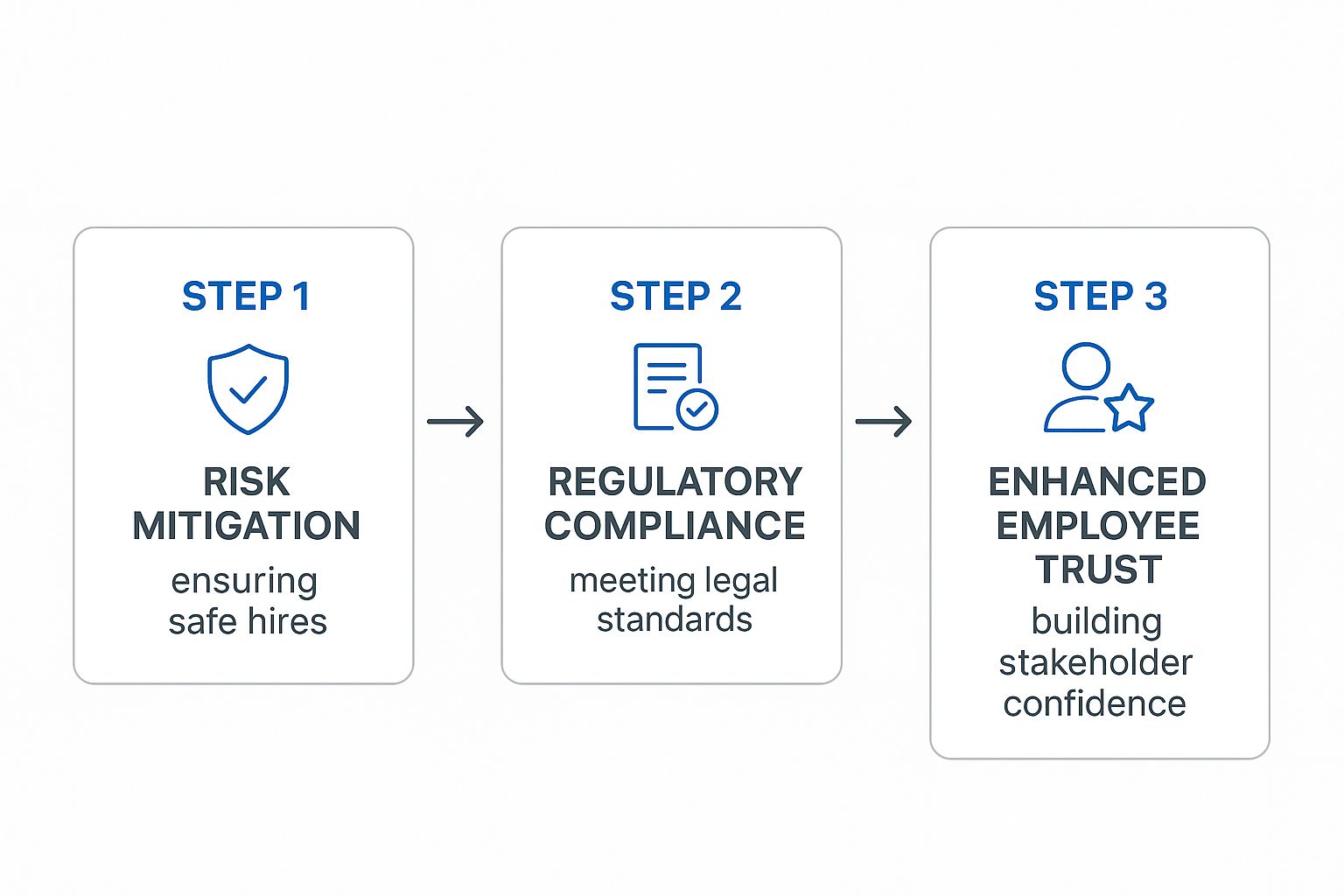
As you can see, the process isn’t just about finding red flags. It’s about methodically confirming that new hires meet the company’s standards for safety, legality, and integrity.
Stage 4: Global Database and Sanctions Screening
Finally, the background verification process in an MNC wraps up with a critical global check: screening against various Global Databases and Sanctions Lists. For any company operating across borders, this step is absolutely essential for managing risk and staying compliant.
These checks make sure a candidate isn’t on any watchlists maintained by governments or international law enforcement agencies. This includes screening for:
- Terrorist watchlists.
- Politically Exposed Persons (PEP) lists.
- Individuals sanctioned for financial crimes like money laundering.
This screening protects the MNC from the disaster of accidentally hiring someone who could expose the company to huge legal and financial penalties. For those curious about the nuts and bolts, you can learn more about how a global database verification works. It’s the final layer of security that upholds an MNC’s integrity on the world stage.
Navigating Global Legal and Compliance Rules
Imagine trying to follow the rules of the road in dozens of different countries all at once. That’s pretty close to what an MNC faces when conducting background checks. A background verification process in an MNC isn’t governed by one universal rulebook; it’s guided by a complex web of international and local laws. Getting this right isn’t just good practice—it’s a legal must.
The entire process hinges on one non-negotiable principle: explicit candidate consent. Before a single check begins, a candidate must clearly agree to it. This isn’t just a formality. It’s the legal key that unlocks the whole process, ensuring every step taken is transparent and above board.
The Foundation of Data Privacy
At the core of all these legal frameworks is data privacy. Laws across the globe are built to protect an individual’s personal information. For an MNC, this means every piece of data collected—from an old payslip to a university degree—has to be handled with extreme care and for a legitimate reason.
Think of it like being the custodian of someone’s personal diary. You can’t just flip through it without permission or share what’s inside. MNCs must have a lawful basis for processing this sensitive information, which is usually tied to the employment contract and the need to build a safe, qualified workforce.
The penalties for getting this wrong are no joke. Non-compliance can lead to massive fines, messy legal battles, and serious damage to a company’s reputation. This is exactly why MNCs are so meticulous about their legal protocols.
A Patchwork of Global Regulations
An MNC doesn’t just follow one set of rules; it has to follow all of them, all at once. The legal landscape is a patchwork quilt of different regulations, each with its own specific demands.
Here are a few of the big ones that shape how MNCs operate:
- General Data Protection Regulation (GDPR) in Europe: This is one of the world’s strictest privacy laws. It sets a high bar, demanding clear consent and giving individuals significant control over their personal data.
- Fair Credit Reporting Act (FCRA) in the US: This law governs how consumer reporting agencies (which includes background check firms) can collect and use an individual’s information, with a strong focus on accuracy, fairness, and privacy.
- Digital Personal Data Protection Act (DPDPA) in India: India’s framework also puts a heavy emphasis on consent and purpose limitation, dictating how the personal data of Indian citizens can be processed.
Navigating this intricate maze requires deep expertise. Companies have to ensure their background verification process in an MNC is tailored to meet the legal standards of every single country where they hire. For a deeper look into these legal demands, you can learn more about the importance of robust compliance frameworks in background screening.
A truly compliant background check is not just about collecting data; it’s about respecting individual rights while safeguarding the organisation. It’s a delicate balance between due diligence and data privacy, and there is no room for error.
This legal tightrope walk is precisely why the verification process is so structured. Every step is designed to be defensible, ethical, and fully compliant with all relevant laws, ensuring the global hiring process is both effective and sound.
How Technology Powers Modern Verification

For a fast-paced global company, running manual background checks is like using a paper map on a high-speed motorway—it’s slow, inefficient, and full of wrong turns. The old way of making endless phone calls, sending emails, and then waiting weeks for a response just can’t keep up anymore. This is where technology completely changes the game, turning the background verification process in an MNC from a dreaded administrative chore into a swift, accurate, and scalable operation.
Today’s verification platforms aren’t just digital filing cabinets. They are powerful engines, fine-tuned to navigate the complexities of global hiring with both precision and speed.
The Power of Automation and AI
At the core of this shift is automation. Instead of a person manually digging through stacks of paperwork, sophisticated software now runs the show. Artificial intelligence (AI) and machine learning, in particular, have been a massive leap forward, offering a level of analysis that humans simply can’t replicate.
For instance, AI-driven tools can:
- Scan Global Databases Instantly: These systems can race through thousands of global criminal, compliance, and sanctions databases in seconds, flagging potential risks far faster than any manual search ever could.
- Detect Document Fraud: Advanced algorithms can analyse digital documents like degrees and ID cards, spotting subtle signs of tampering or forgery that would be invisible to the naked eye.
- Cross-Reference Data: Technology seamlessly compares information across a candidate’s entire file, instantly highlighting any odd inconsistencies between a CV, official records, and submitted proofs.
This automated approach doesn’t just reduce the risk of human error; it also frees up HR teams to focus on the more human, strategic side of hiring.
Instant Verification Through APIs
Another huge leap is the use of Application Programming Interfaces (APIs). Think of an API as a secure, digital handshake between the verification platform and an official data source, like a university’s records office or a government portal.
Instead of waiting for a university registrar to manually look up and confirm a degree, an API sends a secure request and gets a verified, instant response. This direct line of communication delivers trustworthy results in a fraction of the time.
This direct integration is a game-changer for the background verification process in an MNC. It doesn’t just shrink hiring timelines from weeks to days; it seriously boosts the integrity of the information. The data comes straight from the source, which cuts out the risks of third-party miscommunication or forged documents.
A Scalable and Compliant Solution
For any multinational company, the ability to scale is non-negotiable. Technology allows an organisation to run hundreds—or even thousands—of checks at the same time without needing a proportional army of people to manage them. Whether you’re hiring for a new office in Bengaluru or a senior leader in London, the process stays consistent and efficient.
Better yet, these platforms are built with global compliance baked in. They help navigate the tricky web of different data privacy laws, like Europe’s GDPR or India’s DPDPA, by automating consent management and ensuring data is handled according to local rules. This tech-driven foundation makes the entire verification process smarter, faster, and fundamentally more trustworthy.
Handling Red Flags and Discrepancies
So, what happens when a background check turns up something you didn’t expect? A red flag or a discrepancy doesn’t automatically kill a job offer. Instead, it’s the beginning of a careful and considered evaluation. MNCs have been doing this long enough to know that not all inconsistencies are equal—context is absolutely everything.
Think of it like an investigator piecing together a puzzle. A minor mismatch in an employment date might just be an honest mistake. We all forget things. But a pattern of inflated job titles or a degree from a sketchy “diploma mill” hints at a deliberate attempt to mislead. These are the issues that need a much closer look.
The goal here isn’t to play “gotcha” with candidates. It’s about building a complete and truthful picture of their professional history and character to make sure they align with the company’s integrity standards.
Classifying and Evaluating Red Flags
When a discrepancy pops up, HR teams in a multinational will typically classify it based on how serious it is and its relevance to the specific role. The response is almost never a one-size-fits-all rejection; it’s a measured assessment of risk.
Here’s a breakdown of how different red flags are usually seen:
- Minor Inconsistencies: These are often small errors with very little impact. Maybe a candidate listed their last day as July 31st, but company records say it was July 25th. These can typically be cleared up with a quick explanation and maybe a supporting document.
- Moderate Discrepancies: This category covers things like title inflation—where a “Team Contributor” magically becomes a “Team Lead” on their CV. While it isn’t outright fraud, it does show a tendency to exaggerate and certainly raises questions about a person’s honesty.
- Major Discrepancies: These are the real deal-breakers. We’re talking about discovering a fake degree, an undisclosed criminal conviction that’s directly relevant to the job, or significant falsification of work experience. For roles that demand a high level of trust, like in finance or leadership, these issues are almost always non-negotiable.
The weight of any red flag is always balanced against the job’s responsibilities. A poor credit history might be a huge issue for a Chief Financial Officer, but it’s probably irrelevant for a software developer.
The Adjudication Process
Once a red flag is identified, the next step is adjudication. This is the formal process of deciding what to do about the information. A cornerstone of any fair background verification process in an MNC is giving the candidate a chance to tell their side of the story.
A reputable company will never make a hiring decision based on incomplete information. The candidate is almost always given an opportunity to review the findings, provide context, or dispute an inaccuracy. This protects both the candidate from an unfair outcome and the company from potential legal blowback.
For example, an employment verification might come back as “unable to verify” simply because the previous employer’s HR team isn’t responding. By letting the candidate know, they can often provide an alternative contact or documents like payslips to get the check completed.
This kind of transparent approach ensures the final decision is made with a full and accurate set of facts. It transforms the verification process from a simple pass/fail test into a more thoughtful assessment of a candidate’s overall suitability and trustworthiness for a role within a global organisation.
Making the Verification Experience Smooth for Everyone
Let’s be honest: a background check can feel like a bit of an ordeal. But it doesn’t have to be. A well-run background verification process in an MNC isn’t just about ticking compliance boxes; it’s about creating a transparent, professional, and even positive experience for everyone. It sets the tone for your relationship with a new hire, building trust right from the very beginning.
Think of it as a two-way street. For employers, it all starts with a clear, consistent policy. This isn’t just a legal document—it’s your company’s commitment to fairness. This policy needs to clearly explain which checks are done for which roles, how you handle data, and what happens if a discrepancy pops up. Then, it’s all about open communication, so candidates know exactly what’s happening, how long it will take, and what they need to provide.
For candidates, a little preparation goes a long way. Getting your documents in order beforehand can seriously speed things up. If you proactively gather your employment letters, educational certificates, and the correct contact details for your references, you make the whole process smoother for yourself and the company.
For Employers: Creating a Positive Process
A great verification experience really starts with the employer. When you set clear expectations and handle every step ethically, you build a foundation of trust with your future employees. This proactive approach does more than just minimise delays; it cements your company’s reputation as a great place to work.
Here are a few best practices to get you started:
- Establish a Clear Verification Policy: Get it all down on paper. Document exactly which checks you run for specific roles. This creates consistency and fairness, showing everyone that your process is standardised, not just made up on the fly.
- Communicate Transparently: Tell candidates about the verification process right from the start. Let them know what to expect, the typical timeline, and who they can reach out to with questions. No one likes being left in the dark.
- Handle Findings Ethically: If a red flag does appear, don’t jump to conclusions. A fair review process is essential. Give the candidate a chance to see the report and offer an explanation or some context before you make a final decision.
A core principle of a fair process is transparency. By keeping candidates informed, you transform a potentially anxious waiting period into a professional and respectful part of the hiring journey. It shows that you value them as individuals, not just applicants.
For Candidates: Navigating the Checks
As a candidate, you actually have a lot of control over how smoothly the verification process goes. Your accuracy and preparedness are your biggest allies here. Providing clear, correct information from the get-go is the best way to prevent the most common delays and mix-ups.
Here’s some advice for a hassle-free experience:
- Be Honest and Accurate: This is the single most important thing you can do. Double-check the dates, job titles, and names on your CV and application to make sure they line up perfectly with your official records.
- Prepare Your Documents in Advance: Get digital copies of your key documents ready to upload. This usually means your educational degrees, relieving letters from past jobs, and a few recent salary slips.
- Understand Your Rights: You absolutely have the right to know what information is being collected about you and to dispute anything that’s inaccurate. Don’t be afraid to ask for a copy of the final report if you have any concerns.
By following this guidance, both sides can help ensure the background verification process in an MNC is a professional, efficient, and positive step toward a great working relationship. For more guidance on structuring your internal procedures, you can find valuable insights into managing human resources effectively.
Got Questions? We’ve Got Answers
It’s completely normal for both candidates and HR teams to have questions as the hiring process wraps up. Let’s clear up some of the most common ones about the background verification process in an MNC.
How Long Does Background Verification Take?
This is the big one, and the honest answer is: it depends. The timeline for verification can swing quite a bit based on how complex the checks are. For a standard domestic check in India, you’re typically looking at 5 to 15 business days.
However, things can stretch out if international checks are involved, like confirming a degree from a university abroad or verifying employment in another country. That could push the timeline to three or even four weeks. The biggest hold-ups usually come from manual verifications that depend on a human response from a university or a past employer. This is where automated platforms can really speed things up.
What Happens if a Discrepancy Is Found?
First off, don’t panic. Finding a discrepancy rarely means an automatic rejection. A key part of a fair background verification process in an MNC is giving the candidate a chance to explain.
Reputable companies and their verification partners will almost always share the report with the candidate. This is your opportunity to add context, provide extra documents, or clear up what might be a simple misunderstanding.
Small things, like being off by a few weeks on employment dates, are usually resolved with a quick explanation. But of course, major issues like a fake degree or an undisclosed criminal history could lead to the job offer being withdrawn.
Will a Past Minor Issue Disqualify Me?
Not necessarily. MNCs are smart about this; they look at any findings in the context of the role you’re being hired for. It’s all about relevance.
For example, a shaky credit history might be a major red flag for a senior finance role, but it would likely be a non-issue for someone in marketing or software development. The final call always comes down to the nature of the issue, how it relates to the job’s responsibilities, and the company’s own risk policies.
Ready to build a trustworthy team with a seamless and compliant verification process? SpringVerify offers reliable, fast, and accurate background checks tailored for Indian companies. Make your next hire with confidence.


