

Table of Contents
Beyond the Checkbox: What Makes a Background Verification Policy Actually Work
A strong background verification policy is more than just a list of items to tick off; it’s the strategic blueprint that protects an organisation from risk while building a workforce founded on trust. A common mistake is to treat it as a mere administrative task. Instead, think of it as the invisible framework supporting your entire hiring process—when it works well, you don’t notice it, but its absence could lead to serious problems.
The most forward-thinking organisations get this. They’ve moved beyond generic templates to create policies that mirror their specific culture, risk tolerance, and dedication to hiring quality people. This changes the screening process from a bureaucratic delay into a real advantage that attracts top candidates who value security and integrity.

This overview of a background check shows the wide range of data that can be gathered, from criminal records to driving history. A truly effective policy explains why certain checks are needed for specific roles, rather than using a one-size-fits-all approach for everyone.
The Psychology of a Positive Screening Experience
The true measure of a background verification policy isn’t just what it checks, but how it makes candidates feel. A process that is unclear, slow, or feels overly intrusive can put off even the most qualified applicants. Research shows many candidates abandon the hiring process because of a poor experience, and a clumsy verification step is often a key reason. The goal is to strike a balance between being thorough and being respectful.
A policy that succeeds in the real world is built on transparency. Candidates should know:
- What information is being checked and why it’s relevant to the job.
- How their personal data will be managed and kept secure.
- The estimated timeline for the entire verification process.
This clarity demystifies the experience, transforming a potentially stressful moment into a chance to showcase your company’s professionalism. It sends a powerful signal that you are an organised, fair employer who values open communication—qualities that are very appealing to high-calibre talent.
From Document to Daily Practice
Why do so many well-written policies end up gathering dust on a shelf? The reason is often a gap between writing the policy and putting it into practice. An effective background verification policy is a living document, actively used and understood by everyone involved in hiring. It cannot be created in an HR silo.
Leading companies involve key people—like hiring managers, legal teams, and even senior leaders—in its development. This collaborative method makes sure the policy is not only compliant but also practical for those on the recruitment front lines. When managers understand the ‘why’ behind the rules, they become its biggest supporters, ensuring it’s applied consistently. The aim is to build a framework that is clear enough to offer guidance yet flexible enough to adapt to the real-world complexities of hiring.
Navigating Legal Requirements Without Losing Your Mind
Dealing with legal rules can often feel like trying to solve a complex puzzle with missing pieces. Many organisations get stuck in dense legal text, making compliance feel like a burden. However, a well-planned background verification policy is your best guide for meeting these rules without slowing down your operations. The goal is to turn complicated laws into simple, clear actions for your team.
This method changes compliance from just a legal duty into a chance to build trust. When candidates see a transparent and lawful process, it reflects well on your company. They feel respected and safe, knowing their personal information is being handled with care. This isn’t just about avoiding penalties; it’s about creating a positive experience from the moment a candidate connects with you.
The DPDP Act and Its Impact on Your Policy
For companies in India, the rules for data privacy are now much clearer. The Digital Personal Data Protection (DPDP) Act, passed in August 2023, has changed how organisations must manage personal data during background checks. A key part of your background verification policy is getting informed consent from candidates before collecting or using their digital personal information. In fact, over 80% of Indian companies involved in background screening now use clear consent methods like e-signatures or video approvals to comply with the law. You can find more information about background check compliance in India.
This change means your policy must clearly state:
- What data you are collecting.
- The specific reason for collecting it.
- How long the data will be kept.
- Who will see the information.
Getting clear, direct consent is no longer just a good idea—it’s a fundamental part of a legally sound screening process.
To help you understand these changes, here is a breakdown of the key requirements under the DPDP Act and how to implement them.
DPDP Act Compliance Requirements for Background Verification
Key compliance requirements and implementation timelines under India’s Digital Personal Data Protection Act
| Requirement | Implementation Method | Compliance Timeline | Penalty for Non-compliance |
|---|---|---|---|
| Explicit Consent | Obtain clear, unambiguous consent from candidates before collecting personal data. Use consent forms that detail the purpose, type of data, and storage period. | Must be in place for all new data collection post-Act enforcement (projected 2025). | Up to ₹250 crore for significant breaches. |
| Notice and Transparency | Provide a clear, accessible notice to candidates explaining what data is being collected and why. This should be part of the consent form. | Required for all data processing activities from the date of enforcement. | Up to ₹200 crore for failure to fulfil obligations. |
| Purpose Limitation | Only collect and process data for the specific purposes stated in the consent notice. Any other use requires fresh consent. | Applies to all data collected after the Act’s implementation. | Fines up to ₹200 crore. |
| Data Retention Limits | Define a clear data retention period in your policy. Erase personal data once the specified purpose is fulfilled. | Must be implemented for all personal data, including historical data, once the Act is fully effective. | Part of general obligations; non-compliance can lead to penalties up to ₹200 crore. |
| Data Security | Implement reasonable security measures (e.g., encryption, access controls) to prevent data breaches. | Organisations must demonstrate security safeguards from the enforcement date. | Up to ₹250 crore for failure to prevent a data breach. |
This table shows that failing to comply with the DPDP Act can lead to serious financial penalties. A strong policy is your best defence.
Practical Steps for Legal Adherence
You don’t need to be a lawyer to create a compliant policy, but you do need to be meticulous. Start by writing down every part of your verification process, from getting consent to storing data. Your policy should be a clear guide for your HR team, eliminating any confusion. Understanding broader digital regulations and compliance can also provide valuable context.
Think about making a simple checklist for each candidate. Does the consent form clearly list what you are checking? Do you have a secure system for storing sensitive documents? Is there a set time for how long you keep records before deleting them? These practical steps are the foundation of a solid policy. By focusing on these concrete actions, you can manage legal rules with confidence, turning a potential problem into a smooth, trustworthy process that protects both your company and your future employees.
Building Your Policy Foundation: What Really Matters
When it comes to creating a background verification policy, many companies make the mistake of grabbing a ready-made template. While it feels like a quick win, this approach often results in a policy that’s completely out of sync with your company’s real-world risks and needs. The best policies aren’t encyclopedias of rules; they are focused frameworks.
Think of it like building a house. You wouldn’t use a generic blueprint without considering your specific plot of land. You need a solid foundation designed for the local soil, climate, and the type of house you intend to build. A strong background verification policy is the same—it’s built on core components that match your organisation’s unique situation, ensuring your screening process is relevant, fair, and easy for your team to follow. For guidance on creating clear internal documents, exploring guides on how to write effective company policies can be very helpful.
Defining the Scope and Tiers
A one-size-fits-all approach to background checks is not just inefficient; it can also land you in legal trouble. A smarter strategy is to create different verification levels, or tiers, based on the job’s responsibilities and the access it grants. For instance, the checks for a senior finance executive handling company funds will be far more rigorous than for an entry-level intern.
This tiered method ensures your screening is proportional to the risk involved. A well-structured policy clearly states which checks are needed for which roles, preventing unnecessary work while keeping your organisation secure. This is a vital part of effective risk management and successful talent acquisition.
To understand how to layer your checks, it’s helpful to visualise the hierarchy of risk. The table below outlines which verification components are typically recommended for different role levels.
Background Verification Components by Role Level
Recommended verification components based on position level and associated risk factors
| Role Level | Identity Verification | Education Check | Employment History | Criminal Records | Credit Check | Reference Verification |
|---|---|---|---|---|---|---|
| Entry-Level | Essential | Essential | Basic (Recent) | Recommended | Not usually required | Essential |
| Mid-Level | Essential | Essential | Detailed (Multiple) | Essential | For relevant roles | Essential (Detailed) |
| Senior/Executive | Essential | Essential | Extensive | Essential | Recommended | Essential (Extensive) |
| High-Risk Roles | Essential | Essential | Extensive | Essential | Essential | Essential (Extensive) |
This table shows how the depth of verification increases with the seniority and risk of a role. While identity and education checks are fundamental for almost everyone, more sensitive checks like credit history are reserved for positions where they are directly relevant.
The infographic below illustrates the legal compliance structure your policy must follow, starting with broad national laws and narrowing down to specific industry regulations.
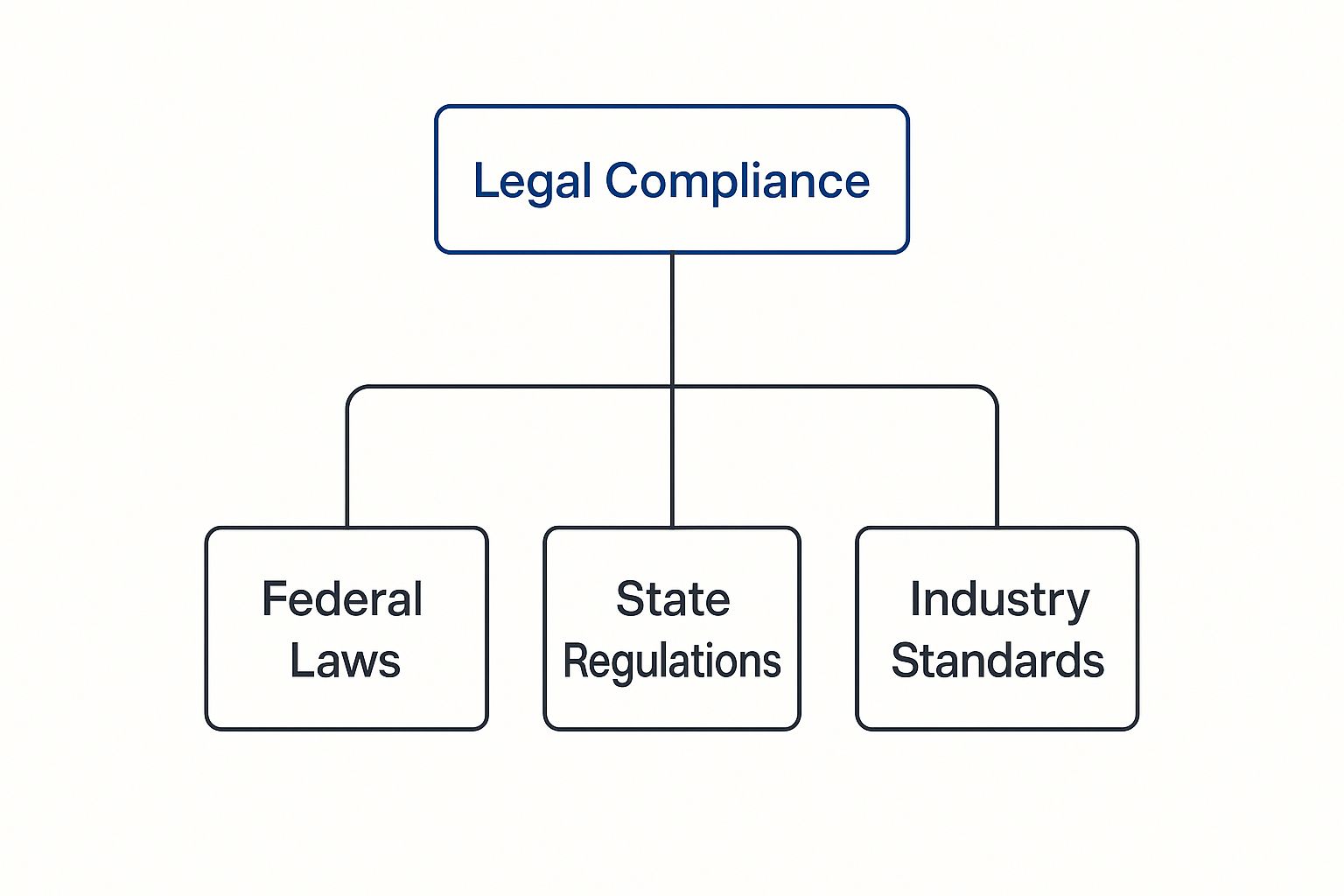
This diagram shows that your policy must first align with overarching federal laws, then narrow its focus to state regulations and finally adhere to standards specific to your industry.
Establishing Clear Decision-Making Criteria
One of the trickiest parts of background verification is figuring out what to do with the information you uncover. What if a candidate’s record has a small error or a past issue? Without clear rules, these situations can lead to inconsistent and potentially unfair decisions.
To prevent this, your policy needs an adjudication matrix. This is a simple framework that guides your team in evaluating findings objectively. It provides clear instructions on how to handle various types of information based on the role’s requirements and the nature of the issue. For example, a minor traffic ticket would be irrelevant for an office job but a major red flag for a delivery driver.
Your matrix should include:
- A clear process for reviewing any negative findings.
- Guidelines on when an individual assessment is necessary.
- Protocols for discussing findings directly with the candidate.
By setting up these clear, written criteria, you promote fairness and consistency in your hiring. This not only protects your organisation from legal risks but also demonstrates your commitment to an equitable process. A well-defined decision-making process is the backbone of an effective and defensible background verification policy.
Learning From the Experts: Banking and IT Sector Insights
Some industries don’t just perform background verification; they have perfected it out of pure necessity. Sectors like banking and information technology (IT) operate in high-stakes environments where trust isn’t just a nice-to-have, but a fundamental requirement for doing business. For any organisation looking to strengthen its hiring integrity, the strategies these sectors have developed offer a masterclass in building a solid background verification policy.
These industries view screening not as a one-time checklist item but as a multi-layered process. Think of it like securing a fortress. A single wall might stop a simple attack, but a real fortress has a moat, high walls, watchtowers, and internal checkpoints. In the same way, banking and IT policies go far beyond a basic criminal record check. They build layers of verification—from identity and education to detailed employment history and even credit checks for certain roles—to guard against a wide array of risks like fraud, data theft, and damage to their reputation.

Adapting Best Practices for Your Organisation
You don’t need to be a large bank to adopt a similar mindset when it comes to security. The main takeaway is to link every verification check to a specific, identifiable risk within your company. For instance, an IT firm might perform deep dives into a developer’s past projects and references to confirm their skills and ensure they have a history of protecting intellectual property. A bank, on the other hand, will conduct detailed financial background checks on employees who will handle customer funds.
The approach is methodical and based on risk. Any organisation can apply this thinking by asking:
- What are the most significant risks associated with this specific role?
- Which verification checks can directly counter those risks?
- How can we clearly document this connection in our policy?
This focused strategy makes your background verification policy more effective and justifiable, as every check serves a clear business purpose.
The Rise of Comprehensive Screening in India
The evolution within these key sectors signals a wider trend. In India, the background verification field has matured significantly, with banking and IT paving the way. Projections show that by 2025, over 75% of major financial institutions and IT companies in India will conduct extensive verifications covering identity, education, past employment, and criminal records. This change is driven by a growing need for trust and compliance, fuelled by digital business operations and tighter regulatory rules. You can discover more insights about background verification trends in India’s key sectors.
The crucial lesson here is that a detailed policy is becoming the norm, not the exception. Companies across all industries can learn from this by shifting towards a more thorough, documented, and role-specific verification process. Adopting these proven strategies helps reduce hiring errors, enhance workforce quality, and build a more secure organisation from the inside out. Ultimately, the goal is to make informed decisions with confidence, a principle that benefits every business.
From Paper to Practice: Making Implementation Actually Happen
Having a well-written background verification policy document is a great start, but it’s only half the job. The real challenge, and where many organisations stumble, is turning that document into a living, consistent part of your hiring process. A policy gathering dust in a digital folder does nothing; its true value is seen only when hiring managers and HR teams apply it correctly every single time. The aim is to make your policy an active tool, not just a forgotten rulebook.
To make this happen, you need more than a company-wide email. It requires a clear strategy built on training, communication, and getting everyone on board. Think of it like rolling out new software: you wouldn’t expect your team to master a new program without training sessions, user guides, and ongoing support. Your policy rollout needs the same careful planning to ensure it actually sticks.
Gaining Buy-In and Training Your Team
The first hurdle you might face is scepticism from busy managers who see a new policy as just more administrative work. The key to winning them over is to show how the policy benefits them directly by making better hires, reducing team turnover, and protecting the company from risk. Instead of just listing rules, explain the ‘why’ behind them. Show them how a structured verification process helps build stronger, more dependable teams.
Once you have their support, training is the next vital step. This shouldn’t be a single, long presentation. Instead, use a mix of formats to keep your team engaged:
- Short workshops that walk through the policy step-by-step.
- Practical case studies showing how to handle common situations.
- Simple checklists and quick-reference guides for daily use.
- A clear point of contact for any questions that come up.
This approach helps ensure the information is understood and that your team feels confident in applying the policy correctly. Consistent application is essential for fairness and legal protection.
Piloting, Measuring, and Refining the Process
Before going all-in, think about running a pilot program with a single department or for a particular role. This small-scale test is an excellent chance to learn, letting you spot unexpected problems and get practical feedback from the team doing the work. Did a step in the process cause unforeseen delays? Was communication with candidates clear enough? These insights are incredibly valuable.
After launching, you need to measure what matters to drive improvement. Track key performance indicators (KPIs) such as:
- Turnaround Time: How long does an average background check take?
- Discrepancy Rate: How often does verification find information that doesn’t match a candidate’s application?
- Candidate Experience: Use simple surveys to find out how satisfied candidates are with the process.
Analysing this data helps you find bottlenecks and fine-tune your background verification policy over time. For example, if turnaround times are always slow, it might be time to look at your vendor or internal workflows. You can learn more about how specialised services conduct different checks, like employment verification, to see where you can find efficiencies. This cycle of piloting, measuring, and refining turns your policy from a static document into a dynamic system that consistently improves your hiring results.
The Future is Here: Continuous Monitoring and Smart Technology
The traditional idea of a one-time background check at the point of hire is quickly becoming outdated. A static check provides a snapshot in time, but it cannot account for changes that occur throughout an employee’s tenure. Forward-thinking organisations are now updating their background verification policy to include continuous monitoring—a more dynamic approach to workforce integrity.
Think of it this way: a pre-employment check is like a home inspection before you buy a house. It tells you the condition on that specific day. Continuous monitoring is like having a smoke detector and a security system installed afterwards; it alerts you to potential problems in real-time, long after you’ve moved in. This ongoing process helps maintain a secure work environment by identifying new risks as they appear, rather than discovering them after an incident has already occurred.

Shifting from Static to Active Verification
Implementing continuous monitoring requires a significant shift in both technology and mindset. It moves the background verification policy from a one-off administrative task to an active, ongoing risk management function. This doesn’t mean constant surveillance. Instead, it involves periodic, automated checks for specific, predefined risk factors, such as new criminal convictions or changes in professional licence status.
The key to successful implementation lies in transparency and trust. Employees must be clearly informed about what is being monitored and why. This communication is essential to prevent a feeling of being watched and instead foster a shared sense of security. An effective policy will clearly outline:
- The types of records that will be checked continuously.
- The frequency of these checks.
- The process for addressing any alerts that are generated.
The Growth of Continuous Checks in India
This evolution is already taking hold in the Indian corporate world. Continuous background checks are becoming a critical part of workforce compliance and integrity monitoring. Unlike old-fashioned, single-point verifications, Indian companies in sectors like fintech and technology are rapidly adopting these ongoing systems. Industry data from 2024-2025 shows that more than 40% of large enterprises in India now use AI-powered continuous background checks, a figure expected to hit 60% by the end of 2025. This adoption is driven by its proven ability to spot risks early and reduce instances of fraud. You can learn more about how 2025’s background check trends are reshaping hiring.
This move towards smart technology and continuous monitoring represents a major step forward. By integrating these practices into your background verification policy, you can protect your organisation more effectively. It’s about creating a system that protects both organisational security and individual privacy throughout the entire employment journey.
Avoiding the Pitfalls: Hard-Won Lessons From the Trenches
Even the most carefully written background verification policy can stumble when put into practice. The space between what’s on paper and what actually gets done is where expensive mistakes are born. Learning from the missteps of others is a shortcut to creating a more durable process. Insights gathered from HR professionals who have faced these challenges reveal common themes where policies often go wrong.
Think of your policy as a recipe. You can have the best ingredients (a well-drafted document), but if the chef (your HR team or vendor) doesn’t follow the instructions, the final dish will be a letdown. The most frequent failures don’t come from a bad policy, but from poor execution. These are the hard-won lessons that can help you avoid common mistakes and make your screening programme stronger.
Pitfall 1: Inconsistent Application of Standards
Applying your policy inconsistently is one of the fastest ways to invite legal trouble. This often happens without any bad intent. A hiring manager in one department might overlook a small discrepancy, while a manager in another department takes a much firmer stance on the same issue. This creates a two-tiered system of fairness, which can easily lead to claims of discrimination.
To steer clear of this, your policy must be applied uniformly. This is where a clear adjudication matrix, as we’ve discussed, becomes absolutely vital. It removes personal judgement and ensures similar findings are handled the same way across the organisation, no matter the candidate or hiring manager.
Pitfall 2: Poor Vendor Management
Outsourcing your background checks doesn’t mean you’re outsourcing your responsibility. A frequent mistake is choosing a vendor and then failing to manage the partnership. An unsuitable vendor can sink your entire programme with slow turnaround times, inaccurate reports, and clumsy candidate communication. This reflects poorly on your employer brand, not the vendor’s.
Effective vendor management involves:
- Setting Clear Service-Level Agreements (SLAs): Define your expectations for turnaround times and quality standards right from the start.
- Regular Performance Reviews: Schedule periodic meetings with your vendor to review their performance against the SLAs and sort out any problems.
- Auditing Reports: Randomly review the quality and accuracy of the reports you get to ensure standards are being upheld.
Treat your vendor like a partner in your hiring journey, not just another service provider.
Pitfall 3: Neglecting the Candidate Experience
For candidates, the background check stage is often a source of stress. Poor communication during this period can tarnish your reputation and cause top talent to withdraw their applications. Candidates left waiting in the dark about delays or who get confusing requests for information will quickly develop a negative view of your organisation.
A positive candidate experience is founded on transparency.
- Proactively Communicate Timelines: Let candidates know how long the process is expected to take.
- Provide Updates on Delays: If a check is taking longer than usual, a quick update can make a world of difference.
- Handle Disputes Fairly: If a candidate challenges a finding, have a clear and respectful process for them to submit corrected information.
A smooth, communicative process reinforces your image as a professional and considerate employer.
Making informed hiring decisions requires more than just a policy; it demands a dependable process. SpringVerify offers fast, accurate, and seamless background verification services built to support your policy and protect your brand. From instant KYC to detailed employment checks, our platform integrates with your existing systems to ensure consistency and a great candidate experience.


