

At its core, background verification is the process of making sure a job candidate is who they claim to be. It’s about doing your due diligence—checking their criminal records, confirming their employment history, and verifying their educational qualifications to see if everything lines up.
Table of Contents
What Background Verification Actually Means for Your Business
Think of your company as a high-performance machine. Every single part needs to be reliable and work exactly as expected for the whole system to run smoothly. Hiring a new employee without a proper background check is a bit like installing a critical component without knowing its history or quality. It might work out fine, or it could lead to a total system failure down the road.
This is what background verification really means for any business. It’s not about trying to catch people in a lie; it’s a proactive strategy to build a foundation of trust and integrity from day one. By simply verifying the details a candidate provides, you’re protecting your company from a whole host of potential problems.
More Than Just a Formality
This process is a non-negotiable part of risk management. A thorough check can bring to light red flags that might otherwise fly under the radar, like a history of workplace issues, made-up qualifications, or even undisclosed criminal activity.
Choosing to skip these checks can open the door to serious trouble:
- Negligent Hiring Claims: If an employee you didn’t vet causes harm, your company could be found liable.
- Reputational Damage: One bad hire, especially in a visible role, can seriously tarnish your brand’s credibility.
- Financial Loss: This can come from anything, from internal fraud to the steep costs of firing and replacing an unsuitable employee.
To see how verification fits into the larger picture of HR, it’s helpful to understand the full scope of human resources practices. Reviewing a comprehensive guide to small business HR can provide valuable context.
Verification is your first line of defence in protecting your company’s culture, assets, and reputation. It ensures that every new hire reinforces the standards you’ve worked so hard to build.
So, what does a standard check actually look at? Let’s break down the essential components you’ll typically find.
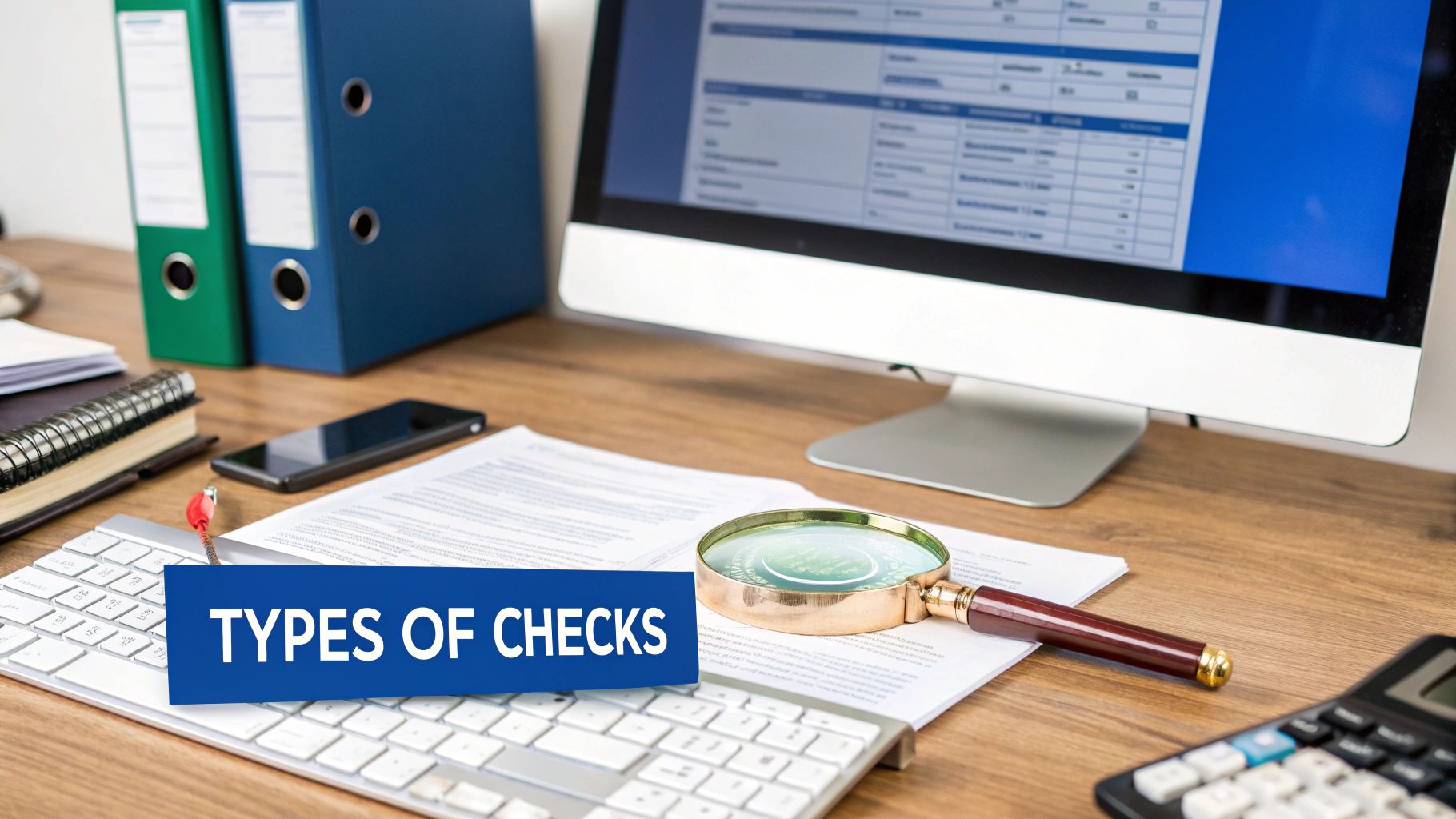
Core Components of a Standard Background Check
The table below outlines the most common types of checks included in a standard background verification process. Each one serves a specific purpose in building a complete picture of a candidate.
| Verification Type | What It Verifies | Why It’s Important |
|---|---|---|
| Identity Verification | Confirms the candidate’s legal name, date of birth, and address using official documents. | Prevents identity fraud and ensures you are hiring a real, identifiable person. |
| Employment History | Checks previous job titles, responsibilities, and dates of employment with former employers. | Validates experience and competence, uncovering any embellished or fabricated work history. |
| Education Verification | Confirms degrees, diplomas, and certifications from claimed educational institutions. | Ensures the candidate possesses the required foundational knowledge and qualifications for the role. |
| Criminal Record Check | Searches police and court databases for any history of criminal convictions. | Crucial for workplace safety and protecting company assets, especially in roles with high trust. |
These checks work together to give you the confidence that you’re making an informed hiring decision, bringing people on board who are both qualified and trustworthy.
Why Background Checks Are More Critical Than Ever in India

The Indian hiring scene is buzzing with more energy and competition than ever. While this is fantastic for unearthing top-tier talent, it’s also created a serious side effect: a sharp increase in fudged resumes and misrepresented candidates.
This isn’t just a small fib on a CV; it’s a major business risk with consequences that can ripple through your entire organisation. The simple background verification meaning has evolved. It’s no longer a box-ticking exercise but your first and most important line of defence.
Think about it. You hire a senior sales head based on a resume that boasts incredible, record-breaking numbers. Months down the line, you discover those figures were pure fiction. The financial hit is obvious, but the real damage goes deeper. Your team’s morale takes a nosedive, trust evaporates, and productivity grinds to a halt as you scramble to clean up the mess.
The Scale of the Problem
That scenario isn’t just a bad dream; it’s a widespread reality. The level of misrepresentation in the Indian job market is genuinely staggering. Recent data shows that in the 2024–25 financial year, over 3.67 lakh individuals failed at least one background check.
These weren’t minor slip-ups. We’re talking about fake educational degrees, heavily embellished job histories, and hidden criminal records. This dramatic rise shows just how seriously companies are now treating this threat. You can explore more on these findings to get a clearer picture of what’s happening.
Skipping a background check is like giving a stranger the keys to your office. You’re trusting them completely, with no real basis for that trust, and hoping for the best.
This tough reality has completely changed how we look at background checks. What was once an optional “nice-to-have” for specific roles is now a non-negotiable part of hiring for any smart Indian company.
Protecting More Than Just Your Bottom Line
The fallout from a bad hire extends far beyond the balance sheet. A single unsuitable employee can poison team dynamics, create an unsafe workplace, and leave a permanent stain on your company’s hard-earned reputation. A proper background verification process is about protecting your most valuable assets.
- Your People: It helps you build and maintain a safe, secure work environment for everyone on your team.
- Your Culture: It reinforces a culture built on integrity, where everyone is accountable to the same high standard.
- Your Reputation: It protects your brand from the damage that can be caused by employees with sketchy pasts.
Simply put, thorough screening ensures the people you bring on board aren’t just qualified on paper. It confirms they are individuals who share your company’s values and can be trusted to help it succeed.
The Hidden Risks of Skipping Checks for Experienced Hires
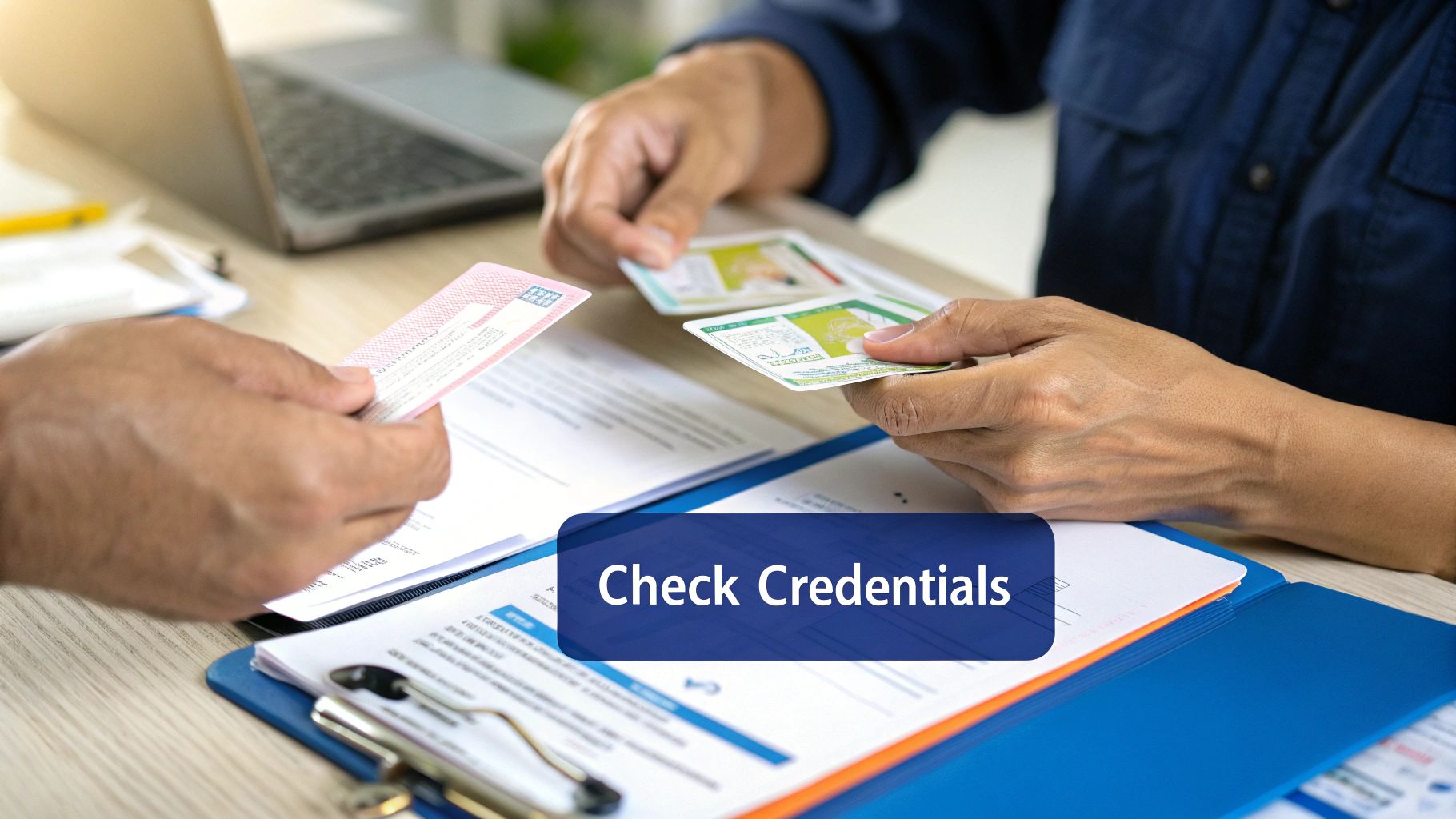
There’s a common and frankly dangerous myth floating around in hiring circles: the idea that senior professionals don’t need the same level of scrutiny as junior candidates. The logic seems to be that a long, successful career is its own background check. But this assumption is a costly one, and it can expose a company to some serious threats.
Let’s be clear: the stakes are exponentially higher when you’re hiring for leadership. A fraudulent senior executive isn’t just a bad hire; they can cause catastrophic damage. They have the keys to the kingdom—access to sensitive company data, influence over strategic direction, and control over large teams.
Think about it. An unverified leader with a hidden history of financial misconduct could cripple company assets and destroy team morale in one fell swoop. This false sense of security is especially dangerous in high-stakes industries like finance, healthcare, and IT, where a seasoned professional’s credibility is the perfect cover for sophisticated fraud.
Experience Is Not A Substitute For Verification
It’s easy to get impressed by a stellar CV and decades of experience. That’s exactly why you need to be diligent. The data on this is startling. A recent EY study found that employment fraud is alarmingly common among experienced professionals in India.
The analysis revealed that fraud cases involving seasoned workers accounted for a staggering 96% in the healthcare sector, 88% in financial services, and 79% in IT/ITeS. These incidents often involved fabricated resumes and fake educational documents, confirming the risk isn’t just with newcomers. You can read the complete findings from the EY report to see the full scope of the problem.
This is precisely why a clear background verification meaning must be applied consistently across all hiring levels. It’s about safeguarding the very core of your organisation.
Assuming an experienced hire is trustworthy without verification is like building the most important floor of your skyscraper on an untested foundation. The potential for collapse is immense.
Why A Thorough Process Is Non-Negotiable
For senior appointments, a comprehensive background check isn’t just a procedural step; it’s a strategic necessity. A detailed verification process protects your leadership team and preserves the integrity of your entire company.
The process must confirm:
- Past Performance: Verifying roles and responsibilities with previous employers is crucial to ensure their track record is genuine. A deep dive into employment verification is essential for confirming this.
- Professional Integrity: For roles with significant responsibility, checking for any history of financial misconduct or criminal activity is absolutely vital.
- Authentic Credentials: Ensuring their acclaimed degrees and certifications are legitimate protects you from serious reputational harm.
Ultimately, applying the same rigorous verification standards to all candidates—regardless of seniority—is the only way to build a truly resilient and trustworthy organisation. It reinforces a culture of accountability and protects your business from the inside out.
Navigating Background Check Compliance in India
This diagram highlights the core pillars of data protection compliance, a critical aspect of modern background verification in India.
When you’re running background checks in India, knowing the rules of the road is just as critical as the checks themselves. This isn’t the Wild West; there’s a strict legal framework in place designed to protect a candidate’s privacy. For any HR leader or founder, getting compliance right isn’t just about ticking boxes—it’s about building a foundation of trust from day one.
Getting this wrong can have serious consequences. The game changed significantly with the introduction of the Digital Personal Data Protection (DPDP) Act in 2023, which put much stricter rules on how companies collect, use, and store candidate information.
And the stakes are only getting higher. With regulations expected to intensify by 2025, falling out of line could lead to penalties as high as ₹250 crore. The law is clear: you need explicit consent from candidates, a very specific reason for collecting their data, and rock-solid protocols for keeping that data safe.
Key Pillars of DPDP Act Compliance
To stay on the right side of the law, you need to build your verification process on transparency and a genuine respect for data privacy. Don’t think of compliance as a hassle. Instead, see it as the operating system for your entire verification programme.
Here are the absolute non-negotiables you must have in place:
- Explicit Informed Consent: You have to get crystal-clear permission from the candidate before you start any checks. This isn’t just a checkbox; the consent form needs to spell out exactly what you’re checking and why.
- Purpose Limitation: Don’t go on a fishing expedition. You can only collect data that is directly relevant and necessary for the job role in question. A one-size-fits-all approach is officially a thing of the past.
- Data Security: All candidate information must be handled like treasure. This means it must be encrypted (think SSL/TLS), stored in GDPR/DPDP-compliant data centres, and only accessible to people who absolutely need to see it.
The Role of a Modern Verification Partner
Trying to navigate this complex legal landscape all by yourself is a massive headache waiting to happen. This is where a modern, tech-forward verification partner becomes an absolute game-changer. A great partner doesn’t just run checks for you; they bake compliance into every single step of the process. They automate the legal heavy lifting, protecting both your company and your candidates.
A compliant verification process shows candidates you respect their privacy and rights, which sets a fantastic tone for the entire employment relationship right from the start.
Choosing a partner who lives and breathes Indian law is crucial. They take on the headaches of managing consent, ensuring data is handled correctly, and providing the audit trails you need to have complete peace of mind. To keep your processes current and bulletproof, it’s smart to see how technology can make these legal duties simpler. You can learn more about SpringVerify’s commitment to compliance to see how a modern approach aligns with these essential regulations.
A Step-by-Step Guide to the Verification Process
Understanding what background verification means is one thing, but seeing it in action really clarifies the whole picture. From the outside, the process can look a bit complicated. But a well-organised system makes it a smooth and transparent journey for everyone involved.
Let’s walk through the process from start to finish. We’ll follow a fictional candidate, Anjali, who has just accepted a job offer. Her new employer uses a professional verification partner, which turns what could be a confusing ordeal into just a few simple, clear steps.
Stage 1: Candidate Consent and Data Collection
The moment Anjali accepts her offer, the process kicks off. She immediately gets a secure, digital link from the verification partner. This isn’t some clunky email chain; it’s a user-friendly portal where her first task is to provide explicit consent for the background check. This is a critical first step for legal compliance.
Once she’s given her consent, the portal guides her to upload the necessary documents and information. It’s pretty straightforward:
- Identity Proof: A digital copy of her Aadhaar or PAN card.
- Educational Certificates: Scans of her degree and any relevant diplomas.
- Employment Details: Information about her previous roles, including company names and dates.
Modern platforms often use automated reminders to gently nudge candidates like Anjali if any information is missing. This ensures the process keeps moving without HR having to send manual follow-ups. It’s a digital-first approach that’s faster, more secure, and creates a much better experience for the candidate.
This infographic gives you a high-level flow of the journey, from data collection to the final report.
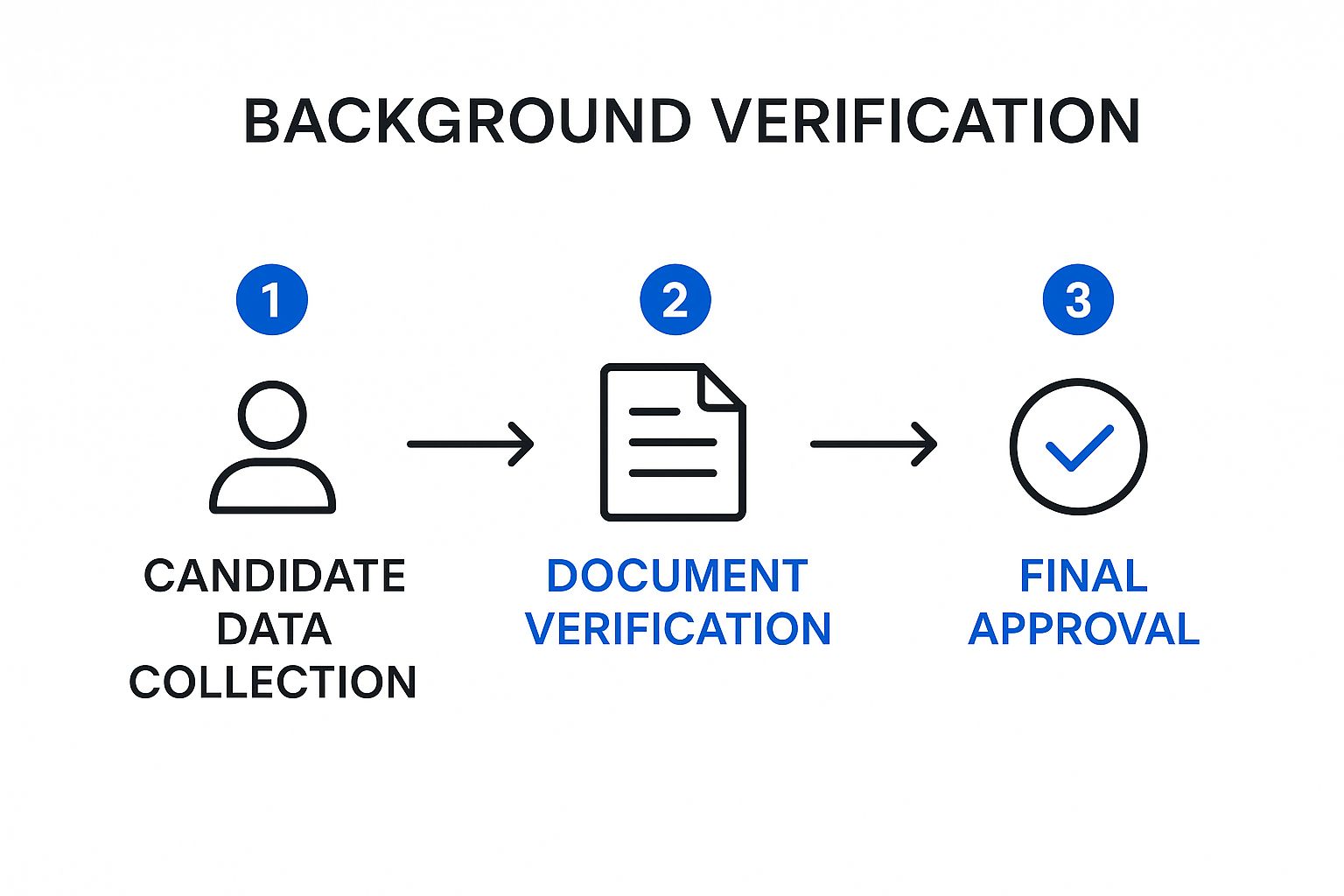
As you can see, a structured process moves seamlessly from the candidate’s input all the way to the final decision.
Stage 2: The Verification and Reporting Phase
With Anjali’s data submitted, the verification partner’s real work begins. This is where technology and human expertise team up to cross-reference all the information she provided. Automated systems connect with university databases to confirm her degree, while verification specialists get in touch with her previous employers to validate her work history.
Each check is a piece of a puzzle. The goal is to assemble them all to create a complete and accurate picture, ensuring there are no inconsistencies or red flags.
As each check is completed, the results pop up on a centralised, secure dashboard. The employer can log in anytime to see real-time progress. Clear, colour-coded statuses show which checks are complete, which are in progress, and which might need a closer look.
Finally, all the findings are pulled together into a comprehensive, easy-to-read report. This final document summarises everything—identity, employment, education, and any other requested checks—and clearly flags any discrepancies. This report gives the employer the confidence to make a final, informed hiring decision, bringing a process built on transparency, speed, and accuracy to a close.
How to Choose the Right Background Verification Partner
Picking a background verification partner is one of the most critical decisions you’ll make for your hiring process. Think of the right partner as an extension of your own team—someone who protects your company and makes your recruitment efforts shine. The wrong one? They can create frustrating bottlenecks, expose you to legal headaches, and even sour your reputation with the very candidates you’re trying to impress.
So, how do you sort the good from the bad? It’s not about ticking off features on a list. You need a partner who delivers real results that tie directly back to your business goals.
Evaluate Partners on Core Capabilities
When you’re comparing vendors, zero in on four key areas that have a direct impact on your hiring success. A truly great partner will excel in all of them, offering a service that’s both balanced and dependable.
- Turnaround Time (TAT): How fast can they actually complete the checks? Slow verification creates a terrible candidate experience and can mean losing your top choice to a competitor who moves faster.
- Accuracy and Reliability: Are their reports thorough and trustworthy? Inaccurate information is far worse than no information at all, as it can lead you to make disastrous hiring decisions.
- Technology and Integration: Do they provide a modern dashboard and API capabilities? The ability to plug into your existing HR systems is a game-changer, automating manual tasks and giving you a real-time view of everything.
- Compliance with Indian Law: How well do they navigate regulations like the DPDP Act? A partner with deep compliance knowledge isn’t a luxury; it’s essential for your peace of mind.
These aren’t just technical specs; they are the very definition of a quality service. A fast TAT isn’t just about speed—it’s about showing respect for a candidate’s time and securing talent before anyone else can. Likewise, strong compliance isn’t just a legal checkbox; it’s a firm commitment to protecting both your business and your future employees.
Selecting a verification partner is about finding a strategic ally who understands that the true background verification meaning is about building trust—with candidates, with your team, and in your hiring decisions.
Ultimately, you want a partner who can grow alongside you. As your company scales, your verification needs will get more complex. You’ll need a provider ready to handle bulk hiring, offer specialised checks, and give you dedicated support when you need it. Investing the time now to find the right fit will pay off immensely, creating a hiring process that’s not just safer, but smoother for everyone involved. For a deeper dive into how these functions support your team, explore our insights into modern human resources practices.
As the idea of background verification starts to take hold, it’s only natural for some practical questions to pop up. Getting to grips with the answers can clear up a lot of the mystery around the process, setting the right expectations for both companies and the people they want to hire.
How Long Does a Background Check Take?
Honestly, it varies. A simple check, like confirming someone’s identity and looking for a criminal record, can be wrapped up in just a few days.
But if you’re doing a more thorough dive—say, verifying employment history with several past companies or confirming degrees from different universities—it’s going to take longer. The biggest factor influencing the timeline is simply how deep you need to go.
Can a Job Offer Be Rescinded After a Bad Check?
Yes, it can. If a background check uncovers major discrepancies or something concerning, a company can withdraw a job offer. This has to be handled with care, though. It’s vital to have a clear, written company policy that spells out what a “failed” check looks like and to apply that standard consistently to every candidate.
At its heart, understanding background verification meaning is about making informed, fair, and legally sound hiring decisions—not just finding arbitrary reasons to disqualify people.
What Information Appears on a Check?
A standard check usually gives you a summary of the essentials: criminal records, employment history, and educational qualifications. But the scope is always shaped by the job itself.
For example, someone in a finance role will likely need a credit history check. A candidate for a driving position? You’ll definitely want to review their motor vehicle records.
And what about getting the candidate’s permission? That’s a must. Under India’s DPDP Act, you are legally required to get explicit, informed consent before you start digging into anyone’s background. This part is completely non-negotiable.
Ready to build a foundation of trust with every hire? SpringVerify offers fast, accurate, and compliant background checks designed for India’s fastest-growing companies. Make informed hiring decisions with confidence by visiting https://in.springverify.com.


