

Think of background verification as the due diligence you perform before making one of the most critical investments for your company: hiring a new person. It’s the process of making sure a job candidate is exactly who they say they are by confirming the details they’ve shared.
This means looking into their work history, educational qualifications, criminal records, and references to see if everything lines up. It’s far more than a simple administrative task; it’s a foundational risk management strategy.
Table of Contents
Why Background Verification Is Your First Line of Defence

Hiring someone without a proper background check is a huge gamble. It’s like buying a house without getting an inspection—sure, you might get lucky and find the perfect place, but you could also be walking into a disaster that will cost you dearly down the road. It’s easy to dismiss verification as just another box to tick, but its true power lies in shielding your organisation from problems you can easily avoid.
A structured background verification employment process is your first and most important line of defence. It’s about building trust from day one and ensuring every new person joining your team has been vetted for honesty and reliability. The goal isn’t to find reasons to say “no,” but to confidently confirm you’re hiring the person you believe you are.
Mitigating Tangible Business Risks
The fallout from a bad hire goes well beyond just poor performance. An unvetted employee can unleash a torrent of serious issues that hit everything from your bottom line to team morale. These aren’t abstract worries; they are real threats with painful, real-world consequences.
Just consider the potential damage:
- Financial Loss: This isn’t just about direct theft or embezzlement. The indirect costs of recruiting and training a replacement can add up to one-third of the employee’s first-year salary.
- Data Security Breaches: For any role with access to sensitive company or client data, an untrustworthy hire is a walking security risk.
- Workplace Safety Concerns: A candidate with a hidden history of violence or serious misconduct could put your current employees in danger, creating a toxic and unsafe work environment.
- Reputational Damage: One incident involving a poorly vetted employee can quickly become a public relations nightmare, eroding client trust and staining your brand’s reputation for years.
A proactive verification strategy isn’t about suspicion; it’s about diligence. It transforms the hiring process from a game of chance into a structured method for building a secure, competent, and trustworthy workforce.
Building a Foundation of Trust
At the end of the day, every new hire is an investment in your company’s future. The verification process is what ensures that investment is sound. It helps you confirm that a candidate’s qualifications are legitimate, their work history is accurate, and there are no hidden red flags that could put your business at risk.
By making background verification employment a non-negotiable part of your hiring protocol, you send a powerful message: integrity and accountability matter here. This not only protects your assets but also strengthens a culture of trust and transparency, creating a more stable and productive workplace for everyone.
Deconstructing a Comprehensive Background Check
A thorough background check isn’t just a single action; it’s more like putting together a puzzle. Each piece—each individual verification—serves a unique purpose. When you fit them all together, you get a clear, reliable picture of a candidate. Think of it like a detective building a case. Every clue adds another layer of evidence, helping you move from assumption to certainty.
This process is all about systematically checking a candidate’s claims to make sure they’re not just qualified on paper, but also trustworthy in practice. Let’s break down the core components that form the foundation of a solid background verification employment strategy.
Confirming Professional History
The first and most fundamental piece is employment verification. Sure, a candidate’s resume lists their past roles and responsibilities, but how can you be certain that history is accurate? This check confirms the essentials: job titles, dates of employment, and sometimes even the reason for leaving.
Discrepancies here can be major red flags. A small mix-up in dates might be an honest mistake, but big exaggerations in job titles or how long they worked somewhere can point to a pattern of dishonesty. Verifying this information ensures you’re hiring someone with the real-world experience they claim to have. To get into the nitty-gritty of this, you can explore our detailed guide on https://in.springverify.com/screenings/employment-verification/.
Validating Academic Qualifications
Next up is education verification. For a lot of roles, a specific degree or certification is a must-have. This check involves contacting universities and other educational institutions directly to confirm a candidate actually earned the credentials they’ve listed.
Imagine hiring a software developer who never finished their computer science degree, or an accountant who doesn’t have a valid certification. It doesn’t just put your projects at risk; it calls the integrity of your whole hiring process into question. The infamous 2007 incident at MIT, where the Dean of Admissions was found to have faked her own degrees, is a stark reminder that no organisation, no matter how prestigious, is immune.
Education verification isn’t just about ticking a box. It’s about confirming the foundational knowledge and qualifications a candidate brings to your organisation, safeguarding the quality of your talent pool.
The infographic below shows how these primary categories come together to form a complete background check.
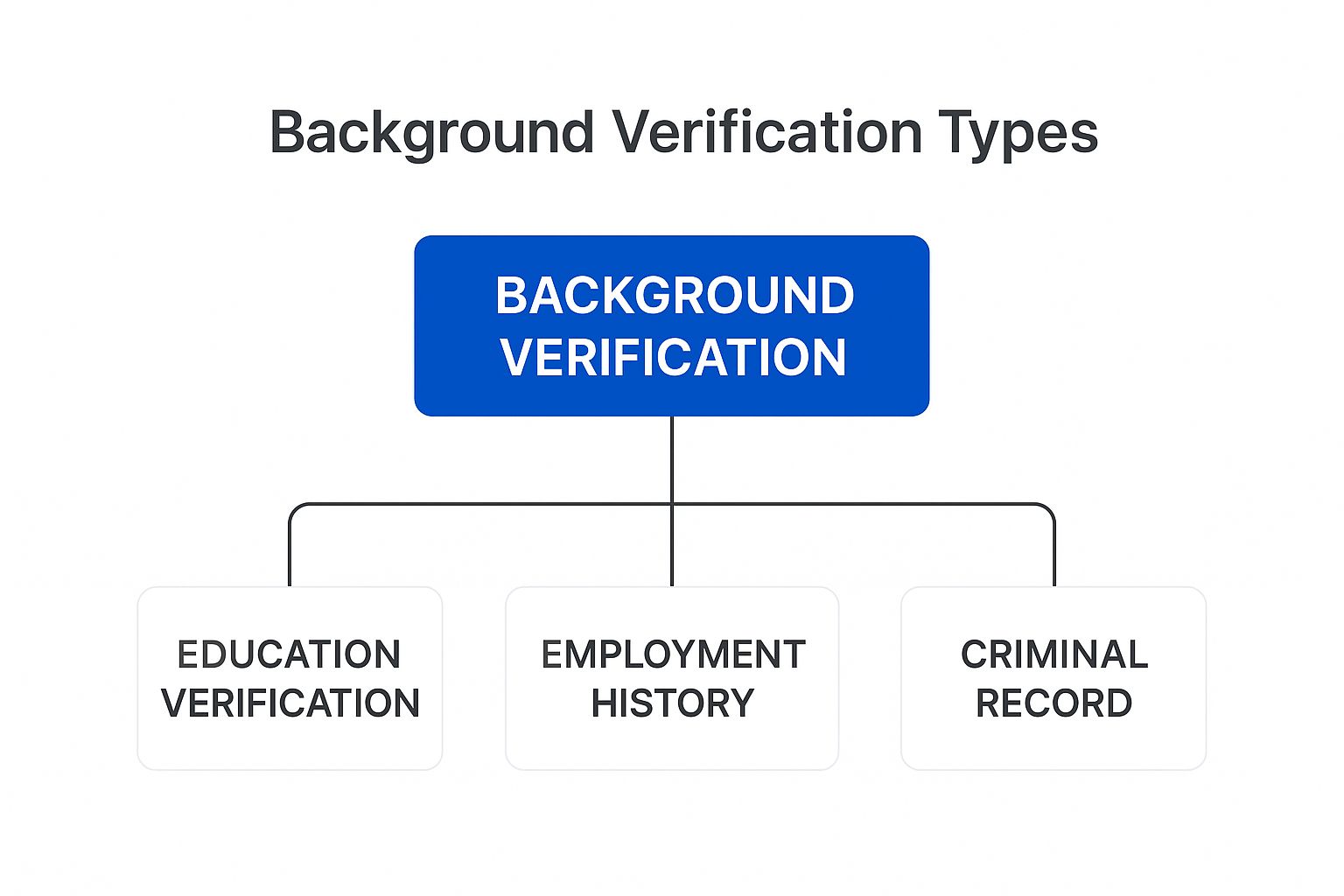
This illustrates how different checks for education, past employment, and criminal history are combined into a single, comprehensive verification strategy.
Key Components of Employment Background Verification
To better understand how these pieces fit together, let’s look at the most common checks in a structured way. Each one is designed to uncover specific information and flag potential issues before they become a problem for your organisation.
| Type of Check | Purpose and Scope | Common Red Flags |
|---|---|---|
| Employment History | Confirms job titles, tenure, and sometimes roles and responsibilities with past employers. | Falsified dates, inflated job titles, undisclosed employment gaps, or claiming to have worked for a non-existent company. |
| Education Verification | Validates degrees, certifications, and attendance dates directly with academic institutions. | Unaccredited institutions, incomplete degrees listed as completed, or entirely fabricated qualifications. |
| Criminal Record Search | Scans court and police records for any history of criminal convictions relevant to the role. | Undisclosed convictions, patterns of behaviour that pose a risk (e.g., fraud, violence), or discrepancies with self-disclosed information. |
| Reference Checks | Gathers qualitative feedback from former supervisors or colleagues on performance and character. | Consistently negative feedback, refusal to provide relevant references, or references who cannot substantiate the candidate’s claims. |
This table highlights that a comprehensive check is about building a multi-layered profile, where each component validates a different aspect of a candidate’s background.
Ensuring Workplace Safety
Perhaps the most critical component for maintaining a safe work environment is the criminal record search. This check scans official police and court records to identify any criminal history that could pose a risk to your company, your employees, or your customers.
The scope of this check has to be relevant to the job. For example, a role in finance would require a close look at any fraud-related offences, while a job that involves driving would naturally focus more on traffic violations. A crucial step in securing your workforce involves implementing a robust comprehensive pre-employment screening process to manage these risks effectively. Skipping this step can leave your organisation wide open to negligent hiring claims and create an unsafe workplace for everyone.
Gaining Deeper Performance Insights
Finally, reference checks provide the kind of qualitative insights that other verifications simply can’t. While other checks are about confirming facts, references give you context about a candidate’s actual performance, their work ethic, and how they get along with others.
By speaking with former managers or teammates, you can learn about a candidate’s strengths, areas where they might need support, and their overall fit within a team. It’s your chance to ask specific questions about their contributions and how they handle real-world challenges. This part of the process adds a human element, helping you understand not just what a candidate has done, but how they did it. When all these pieces are finally assembled, you have a complete, fact-based picture to guide your hiring decision.
Navigating Employee Screening Laws in India

Running a thorough background verification employment check isn’t a free-for-all. It’s a process guided by a strict legal framework built to protect individual privacy. For any company in India, staying on the right side of these laws isn’t just good practice—it’s an absolute must. Getting it wrong can lead to heavy penalties, messy legal fights, and a serious dent in your company’s reputation.
Think of these laws as the rules of the road for hiring. You can’t just drive wherever you want; you have to follow the signs to keep everyone safe. In the same way, you need to navigate the legal landscape carefully to protect both your organisation and your candidates’ rights.
The Cornerstone of Compliance: Consent
If there’s one principle that stands above all others in Indian employee screening law, it’s consent. Before you even think about running a check—whether it’s for past jobs, education, or criminal records—you must get explicit, written permission from the candidate. This is not a step you can afford to skip or bury in the fine print.
And this consent has to be “informed.” That means the candidate needs to know exactly what you’re checking and why. A vague, catch-all clause tucked away in an application form just won’t cut it. Your consent form should clearly spell out every type of verification you plan to carry out.
Consent is the non-negotiable gateway to a lawful background check. Proceeding without clear, written, and informed permission from the candidate is a direct violation of their privacy rights and exposes your organisation to serious legal risk.
This simple act ensures the candidate is an active participant in the process, not just a subject under a microscope. It immediately builds a foundation of transparency and respect, setting the right tone from the very start.
Understanding the DPDP Act 2023
The rulebook for data privacy in India got a major update recently. The Digital Personal Data Protection (DPDP) Act, 2023, has put strict new rules on how companies collect and handle a candidate’s personal information. This makes secure and lawful data management mandatory for any background check.
The act casts employers in the role of ‘Data Fiduciaries,’ giving you clear responsibilities for how you manage personal data. For your hiring process, this boils down to a few key duties:
- Collect Purposefully: Only gather the data you absolutely need for the employment verification. Nothing more.
- Store Securely: You must have strong security measures in place to shield candidate data from breaches or unauthorised eyes.
- Use Ethically: The information you collect can only be used for the reason you got consent for—making a hiring decision.
- Retain Mindfully: Don’t hang onto candidate data forever. You need a clear data retention policy and a secure way to get rid of the information when it’s no longer required.
Failing to follow these principles under the DPDP Act can lead to some pretty substantial fines.
Practical Steps for Lawful Screening
Getting this right isn’t just about what you do, but also about being able to prove you did it correctly. It requires a systematic, well-documented approach.
To make sure your background verification employment process is fully compliant, focus on these concrete steps:
- Draft a Clear Consent Form: Don’t try to wing this. Work with a legal expert to create a consent form that is simple, specific, and easy for anyone to understand.
- Establish a Written Policy: Create an official, internal background screening policy. This ensures every candidate is treated fairly and consistently.
- Partner with Compliant Vendors: If you’re using a third-party screening service, it’s on you to ensure they are also fully compliant with Indian laws, especially the DPDP Act. Their compliance is your compliance.
- Handle Adverse Action Properly: If a background check turns up something that makes you reconsider an offer, you have to follow a fair process. This usually means telling the candidate about the findings and giving them a chance to explain or challenge them.
By weaving these legal guardrails into your hiring workflow, you not only protect your organisation but also build a screening programme that is fair, transparent, and legally sound. For a deeper look into the specifics, check out our guide on achieving hiring compliance in India.
Understanding the True Cost of a Bad Hire
The immediate fallout from a bad hire is easy to spot. Missed deadlines, shoddy work, and the sheer frustration of restarting the entire hiring process. But that’s just the tip of the iceberg. The real damage runs much deeper, spreading quietly through an organisation like an unseen crack in a foundation. The cost is far more than just the salary you paid to the wrong person.
When you cut corners on the background verification employment process, you aren’t saving money; you’re gambling with your company’s future. The tangible financial drains are bad enough, but it’s the hidden, long-term costs that can truly cripple a business. A single poor hiring decision can sink team morale, shatter client trust, and poison a healthy company culture.
The Direct Financial Impact
Let’s start with the hard numbers—the expenses that show up directly on your balance sheet and are the easiest to tally.
- Recruitment Expenses: Think about the cost of job postings, any agency fees, and the countless internal hours your team spent sourcing, interviewing, and onboarding.
- Training and Development: Every new employee is an investment. When they don’t work out, that entire investment in their training and development walks out the door with them.
- Salary and Benefits: This is the most obvious one. Any compensation paid to an underperforming or problematic employee is a direct loss with absolutely zero return.
- Severance Pay: If a formal separation is needed, severance packages and potential legal fees pile on another layer of direct costs.
These expenses add up alarmingly fast. In fact, one report found that a bad hire can cost a company up to one-third of the employee’s first-year salary. It’s a stark reminder of just how wasteful a flimsy verification process can be. The study also highlighted that discrepancies are often found after a job offer is made, leading to squandered time and money. You can find more insights from AuthBridge’s 2025 report on hiring red flags in India.
The Hidden Costs You Cannot Ignore
Beyond the immediate financial hit, the indirect costs are often far more destructive. These consequences are harder to pin down on a spreadsheet but can hobble a team and stunt a company’s growth for years.
A bad hire is like a slow leak—it may not cause a flood overnight, but over time, it drains resources, lowers morale, and weakens the entire structure of your team. The upfront cost of a thorough background check is the small price you pay to prevent a catastrophic failure later.
Just think about the ripple effects:
- Lost Productivity: It’s not just about the bad hire’s lack of output. Your best people get dragged into picking up the slack, correcting mistakes, and dealing with constant disruptions. This pulls them away from their own critical tasks.
- Damaged Team Morale: Nothing disengages high-performers faster than watching a colleague fail to pull their weight without any consequences. This frustration quickly turns into a drop in motivation and, eventually, a rise in turnover among your top talent.
- Strained Client Relationships: If the role is client-facing, a bad hire can directly tarnish your company’s reputation. Poor service, missed deadlines, or unprofessional behaviour can lead to lost clients and a nosedive in revenue.
- Eroded Company Culture: Your culture is built on shared values like trust, competence, and integrity. Bringing someone in who undermines these values sends a clear message that your standards are negotiable, weakening the very core of your organisation.
Ultimately, a robust background verification employment process isn’t just a box to tick—it’s one of the smartest, most cost-effective investments a business can make. It’s a proactive strategy to shield your finances, your team, and your reputation from the immense and often irreversible damage of a bad hire.
How Technology Is Outsmarting Modern Hiring Fraud
Spotting a typo on a resume used to be a clear red flag. Those days are long gone. Today’s hiring fraud has become a sophisticated operation, with deceitful candidates using advanced tools to create fake credentials, juggle dual employment, and even use deepfakes in virtual interviews.
This level of high-tech deception demands an equally advanced defence. Old-school, manual verification methods are simply too slow and clumsy to catch modern fraud. This is precisely where technology steps in, transforming background verification employment from a simple checklist into a proactive security measure.
The Modern Threats to Hiring Integrity
The landscape of hiring fraud is constantly shifting as tricksters find new and creative ways to beat the system. An EY study brings several of these tech-driven challenges to light, including a rise in sophisticated fake job documents and widespread resume fraud. The report also flags growing concerns around dual employment and deepfake-powered interviews, making the case for technology-driven verification crystal clear. You can read more about these rising risks across sectors.
Let’s break down the main threats employers are up against:
- Sophisticated Document Forgery: Fake degrees and experience letters are now crafted with professional design tools, making them almost impossible to tell apart from the real thing with the naked eye.
- Resume and Skill Fraud: A shocking number of resumes contain major misrepresentations, from slightly inflated job titles to completely fabricated work histories.
- Dual Employment Schemes: Some individuals manage to hold down two full-time jobs at the same time, all without either employer knowing. This inevitably leads to conflicts of interest and a serious drop in productivity.
- Deepfake Interviews: AI-generated video and audio can be used to have someone else impersonate a candidate during a virtual interview, completely fooling recruiters.
These threats make it obvious that a manual, trust-based approach just doesn’t cut it anymore if you want to protect your organisation’s integrity.
In this new era of hiring, technology isn’t just an efficiency tool; it’s your primary defence against calculated deception. It acts as an unbiased, data-driven gatekeeper that can spot anomalies a human eye might miss.
Technology as a Powerful Countermeasure
To fight back against these advanced threats, the background verification employment process has to evolve. Modern verification platforms are now armed with powerful tools that automate checks and boost accuracy, offering a solid defence against fraud.
Automated systems can cross-reference data from thousands of sources in seconds, flagging inconsistencies that would take a human verifier days to even find. For instance, AI algorithms can analyse a document’s metadata to spot signs of digital tampering or use biometric data to confirm a candidate’s identity during remote onboarding. This level of scrutiny is absolutely essential for a secure and trustworthy hiring process.
What’s more, these platforms provide a clear, auditable trail for every single check performed. This ensures your verification process is not only effective but also fully compliant with data protection laws. By integrating advanced tools like robust digital identity verification, companies can confidently confirm a candidate is exactly who they claim to be, right from the very first step. Technology is no longer just speeding things up; it’s fortifying the entire process against the cleverest forms of fraud.
Building Your Own Effective Verification Program
Putting the principles of thorough screening into a concrete, working system is where the rubber meets the road. Building an effective background verification employment program is a bit like drawing up the blueprint for a house; you need a clear plan, consistent application, and the right tools to make sure the final structure is solid and secure. A well-designed program doesn’t just react to hiring needs—it proactively strengthens your organisation from the ground up.
This isn’t just about picking a vendor and hoping for the best. It’s about defining your standards, ensuring fairness, and strategically aligning your checks with the specific risks tied to different roles in your company. A haphazard approach can create inconsistencies and legal headaches, but a structured program becomes a powerful strategic asset.
Start with a Written Policy
The absolute bedrock of any strong verification program is a clear, written policy. Think of this document as your organisation’s single source of truth. It needs to outline exactly what will be checked, for which roles, and why. Most importantly, it ensures every candidate goes through the same fair and consistent process—a non-negotiable for legal compliance.
Your policy should detail:
- The types of checks you’ll run (e.g., employment, education, criminal).
- Which checks apply to different job levels or departments.
- The procedure for getting a candidate’s consent.
- How you’ll handle discrepancies or negative findings.
Having this in writing removes all the guesswork. It also protects your company from claims of discrimination by proving that your screening process is applied uniformly to everyone applying for similar roles.
Tailor Checks to the Role
Let’s be honest, not every role carries the same level of risk. A one-size-fits-all approach to background checks is both inefficient and a waste of money. Your verification program should be tiered, meaning the depth of the screening should directly match the responsibilities of the job. This is a core principle of effective background verification employment.
For instance, an entry-level cashier might only need their identity and criminal record verified. A Chief Financial Officer (CFO) candidate, on the other hand, warrants a much deeper dive, including checks on their credit history, extensive employment verification, and searches for any regulatory sanctions.
A tiered approach ensures your resources are allocated intelligently. It focuses the most intensive screening efforts where the risk is highest, protecting your organisation’s most critical assets, data, and finances without over-screening for lower-risk positions.
This kind of strategic customisation makes your program more relevant and cost-effective.
Choose the Right Verification Partner
For most companies, trying to manage the entire verification process in-house is simply not practical. Partnering with a professional third-party screening provider is often the smartest move. A good partner brings expertise in legal compliance, access to extensive databases, and the technology to deliver fast, accurate results.
When you’re vetting vendors, look for a partner who understands the nuances of Indian law, offers easy integration with your existing HR systems, and provides clear, easy-to-read reports. A reliable partner becomes an extension of your HR team, making sure your program is not only robust but also runs like a well-oiled machine.
Finally, remember that a truly effective program looks beyond just screening candidates. It involves an ongoing assessment of your entire workplace environment. A critical part of this is regularly conducting a Workplace Health and Safety Audit to ensure a safe and compliant environment for everyone. This holistic view of risk management, from pre-hire to post-hire, is what separates a good program from a great one.
Frequently Asked Questions
Even when you’ve got a handle on the basics, real-world questions always pop up when you start running background checks. Here are a few of the most common queries we hear from employers, with straightforward answers to help you navigate the process.
How Long Does a Typical Verification Take in India?
The timeline for a background check can really vary, and it all comes down to how deep you need to dig. Simple verifications, like confirming an identity or address, are usually quite fast and can be done and dusted in 1-3 days.
But for a more comprehensive check that looks into past employment, education, and criminal records, you’ll need a bit more patience. These deeper dives typically take anywhere from 5 to 15 business days. The most common hold-ups? Waiting for previous employers or universities to get back to us. It’s a frequent hurdle, but a manageable one.
Must I Inform a Candidate Before a Check?
Yes, you absolutely must. Getting clear, written consent from a candidate before you kick off any background verification is a non-negotiable legal requirement in India. This isn’t just a best practice—it’s mandated by data privacy laws like the DPDP Act 2023.
Trying to run a check without consent is a serious legal misstep. Your consent form needs to be crystal clear, explaining exactly what you’ll be checking and how their personal information will be handled.
Skipping this step can land your company in hot water, with significant legal and financial consequences.
What Happens If a Discrepancy Is Found?
Finding a discrepancy doesn’t have to be an immediate deal-breaker. The fairest and most standard approach is to go back to the candidate and give them a chance to explain. They might have documents to clear things up or a simple explanation for the inconsistency. A minor mix-up, like being off by a few weeks on employment dates, is often just an honest mistake.
On the other hand, a major red flag—like a completely fabricated degree or a phantom past employer—is a different story. This is where your company’s internal policy becomes critical. Depending on how serious the issue is, you might decide to withdraw the job offer. Having a clear, consistently applied policy for these situations is your best defence for staying fair and legally sound. The key is to investigate, communicate, and then make a decision based on the facts.
Ready to build a hiring process grounded in trust and accuracy? SpringVerify offers fast, reliable, and compliant background verification services designed for Indian companies. Streamline your hiring and make confident decisions by visiting https://in.springverify.com to learn more.


