

Hiring someone new is a leap of faith, but it’s a leap that needs a safety net. Thinking about background investigation services isn’t about being suspicious; it’s about building a solid foundation of safety, integrity, and competence for your entire company. You can look at it as a form of quality control for your most important asset: your people.
Table of Contents
Why Background Investigation Is a Non-Negotiable Business Shield

Bringing a new team member on board without a proper background check is a bit like handing a stranger the keys to your office and just hoping for the best. While that kind of optimism is admirable, the potential risks are huge. In India’s modern economy, what might seem like an optional HR task has become an essential line of defence for any business.
Every person you hire introduces a new element into your company’s ecosystem. The right person can lift the whole team up, but a bad hire? The consequences can stretch far beyond just poor performance. These aren’t just abstract risks; they show up in real, damaging ways.
The Real-World Consequences of a Bad Hire
A single poor hiring choice can send ripples through your organisation, affecting everything from your finances to team morale. Getting to grips with these specific risks really drives home why a proactive approach is so vital for stable, long-term growth.
Here are the key areas where you’re vulnerable:
- Financial Loss: This isn’t just about the recruitment costs and salary. It can mean theft, embezzlement, or even losses from bad decisions made by an unqualified person that damage client relationships or mess up your operations.
- Reputational Damage: An employee’s actions can quickly become tied to your brand’s name. Unethical behaviour, terrible customer interactions, or any kind of public misconduct can undo years of trust you’ve worked hard to build.
- Compromised Workplace Safety: One of an employer’s biggest responsibilities is to provide a safe environment. A background check can uncover past behaviours or criminal records that might signal a threat to other employees.
- Reduced Productivity and Morale: A team member who is unqualified, dishonest, or just plain disruptive can be a massive drain on resources, pulling down the whole team’s spirit and output.
A thorough background investigation is your first line of defence. It’s not just about filtering out the wrong people; it’s about proactively confirming you’re bringing in the right ones who will champion your company’s values.
The Growing Threat of Resume Fraud
The problem of candidates misrepresenting themselves is far more common than most businesses think. A recent study by Ernst & Young (EY) showed that employment fraud in India is on the rise, with some pretty shocking figures across major industries. For example, a staggering 83% of healthcare applicants failed their background checks, and 96% of the fraudulent candidates in that sector were experienced professionals. You can read the full insights on employment fraud from EY.com to see just how deep this issue runs.
This data proves one thing loud and clear: years of experience are no guarantee of honesty. That makes proper verification an absolutely non-negotiable step in your hiring process.
Breaking Down a Comprehensive Background Check
A thorough background investigation isn’t a single check-the-box activity; it’s a multi-layered process. Think of it like assembling a puzzle. Each piece—a criminal record check, an employment verification, a credentials check—gives you a different part of the picture. Only when you put them all together do you see the full, clear image of a candidate.
This layered approach is precisely what makes professional background investigation services so powerful. It’s about moving beyond a simple pass/fail and gaining real insight into who you’re bringing onto your team.
Understanding these individual components helps you see how a complete screening package is built to protect your organisation.
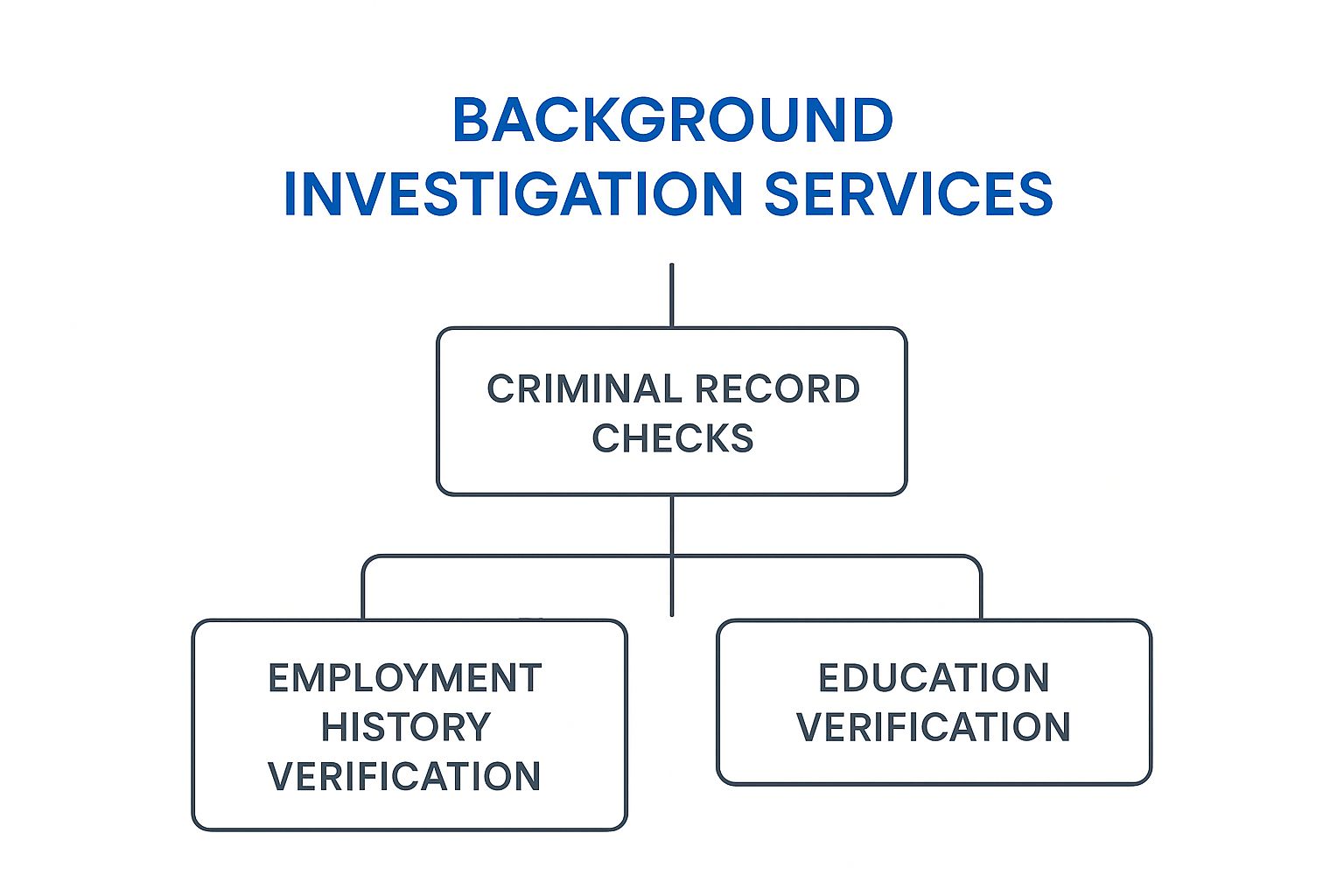
As you can see, a single verification is just one part of a much larger, more robust strategy designed to safeguard your business. Let’s look at the core components.
Criminal Record Checks
This is usually the first thing that comes to mind when people hear “background check,” and for a good reason. A criminal record check is a cornerstone of workplace safety. It involves a deep dive into court records and police databases to uncover any past criminal convictions.
The goal isn’t to punish someone for a past mistake. It’s about assessing potential risks relevant to the job. For instance, a history of financial fraud would be a massive red flag for an accounting role. Likewise, a record of violent offences is a serious concern for any position involving teamwork or public interaction. These checks are absolutely essential for protecting your people, your assets, and your company’s reputation.
Employment History Verification
Did the candidate really work as a Senior Manager for three years? Were those employment dates accurate? Employment history verification gets you the straight answers by contacting previous employers to confirm the details on a candidate’s CV.
This check is your best defence against CV inflation. It quickly uncovers everything from slightly puffed-up job titles to completely fabricated work experiences. Making sure a candidate’s past roles and responsibilities are genuine ensures you’re hiring someone with the actual experience needed to succeed, preventing a costly bad hire down the road.
A candidate’s past performance and professional conduct are strong indicators of their future behaviour. Verifying employment history isn’t just about fact-checking; it’s about gaining predictive insight into their reliability and integrity.
Education and Credential Validation
For any role that demands specific qualifications—whether it’s a university degree, an industry certification, or a professional licence—this check is non-negotiable. Education verification involves contacting academic institutions and licensing bodies directly to confirm a candidate’s claimed credentials are real and in good standing.
This simple step stops you from hiring someone who lacks the foundational knowledge to do the job. It cuts down the risk of incompetence and protects your business from the legal and financial fallout that can come from having an unqualified person in a critical role.
Each of these checks delivers a unique piece of information. When you combine them, you get a detailed and dependable portrait of a candidate, allowing you to make hiring decisions based on verified facts, not just gut feelings from an interview.
To better understand the components of a thorough investigation, considering the elements involved in effective tenant screening can be highly informative, as many of the principles of risk mitigation are similar.
The table below breaks down the most common checks and what they’re designed to protect you from.
Core Components of Background Investigation Services
| Type of Check | What It Verifies | Primary Risk Mitigated |
|---|---|---|
| Criminal Record Check | Searches court and police databases for past convictions. | Workplace safety threats, theft, fraud, and reputational damage. |
| Employment Verification | Confirms job titles, responsibilities, and dates of employment. | Hiring unqualified candidates, CV fraud, and poor performance. |
| Education Validation | Authenticates degrees, certifications, and professional licences. | Incompetence in skilled roles, compliance violations, and legal liability. |
| Identity Verification | Confirms the candidate is who they claim to be using official documents. | Identity fraud and ensures all subsequent checks are run on the right person. |
| Reference Checks | Gathers qualitative feedback on skills, work ethic, and team fit. | Poor cultural fit, interpersonal issues, and performance problems. |
| Credit History Check | Reviews financial reliability for roles with financial responsibility. | Financial mismanagement, embezzlement, and internal fraud. |
By strategically selecting the right mix of these checks, you can tailor your background investigation process to the specific needs and risk levels of every role in your organisation. This thoughtful approach gives you the clarity needed to build a team you can truly trust.
Navigating India’s Legal and Compliance Maze

Conducting background checks in India isn’t just about verifying a few facts on a resume. It’s about carefully navigating a complex maze of legal and ethical guidelines. Think of it as the official ‘rules of the road’ for hiring. Getting these rules right isn’t just about dodging penalties—it’s about building a foundation of trust with your candidates and shielding your organisation from some serious legal heat.
The whole process boils down to one core principle that is absolutely non-negotiable: explicit candidate consent. Before you even think about starting a background check, you must have clear, written permission from the applicant. This isn’t a friendly suggestion; it’s a legal mandate that upholds an individual’s right to privacy and forms the bedrock of any compliant screening programme.
Without that consent, any information you collect could be considered illegal, landing your company in a very tricky legal spot. Making consent the first, unskippable step in your workflow is crucial for a process that’s fair, transparent, and legally sound.
Understanding Key Data Protection Laws
India’s legal framework around data privacy has grown much stronger in recent years, which directly impacts how background investigation services have to operate. Two major laws that every HR professional needs to have on their radar are the Information Technology (IT) Act, 2000, and the more recent Digital Personal Data Protection Act (DPDPA), 2023.
The IT Act, specifically Section 43A, sets the ground rules for protecting sensitive personal data. It requires any company handling this kind of information to put reasonable security practices in place. If they don’t, and it leads to a wrongful loss for someone, the company can be held liable for damages. This makes it incredibly important to pick a verification partner who takes data security seriously.
The DPDPA takes these protections even further. It lays out clear guidelines on how personal data can be collected, processed, and stored. It doubles down on the importance of consent, purpose limitation (only using data for the reason you stated), and data minimisation (only collecting what you absolutely need). For HR teams, this means your screening policy has to be crystal clear about what checks you’re running and why they’re relevant for that specific job.
Under the DPDPA, organisations are now considered ‘Data Fiduciaries,’ which means they are legally responsible for protecting the personal information they handle. This makes having a meticulously compliant background screening process more important than ever.
Building a Legally Sound Screening Policy
A well-defined internal screening policy is your best line of defence against legal troubles. It creates consistency, fairness, and transparency for every single hire. Your policy shouldn’t be a rigid, one-size-fits-all document. Instead, it should be a flexible framework that you can adapt for the different roles across your company.
Here are a few practical steps to build a compliant policy:
- Obtain Explicit Consent: Make this the first thing you do, every time. Use a simple, easy-to-understand consent form that spells out exactly what checks you plan to run.
- Ensure Relevance: Don’t run checks just for the sake of it. A credit history check might make sense for a finance manager, but it’s probably completely irrelevant for a graphic designer. Stick to what’s necessary for the job’s duties.
- Maintain Transparency: Be upfront with candidates about your background check policy. Mention it in the job description or bring it up during the first interview stages so there are no surprises.
- Secure Data Handling: Team up with a verification service that follows strict data protection standards. You need to be sure that candidate information is encrypted, stored securely, and only seen by people who are authorised to see it.
Putting together a compliant framework can feel like a big task, but it’s a non-negotiable part of modern HR. For a deeper look into the nitty-gritty details, exploring a guide on comprehensive compliance for background checks in India can offer invaluable clarity and actionable steps. By making these principles a priority, you can confidently use background investigation services to build a team you can trust, all while respecting candidate rights and keeping your business out of legal trouble.
The Tech Revolution in Employee Verification
Let’s be honest, the old way of doing background checks was a slog. It was a world of manual paperwork, endless phone calls, and crossed fingers. Think of it like trying to navigate a new city with a folded paper map. It got you there eventually, but it was slow, you’d often make a wrong turn, and you couldn’t adapt to roadblocks in real-time.
Today’s tech-driven approach is the live GPS for hiring. It’s faster, far more accurate, and massively more efficient at verifying a candidate’s history. This isn’t just a minor upgrade; it’s a complete transformation powered by automation and artificial intelligence (AI). Modern platforms can now do in minutes what used to take days, connecting directly to databases, cross-referencing information, and flagging issues with incredible speed.
This shift allows HR teams to step away from being administrators buried in paperwork and step into their role as strategic decision-makers, armed with reliable, verified data. The result is a screening process that isn’t just faster—it’s fundamentally smarter.
How AI Is Redefining Accuracy and Speed
AI-powered systems are built to chew through immense volumes of data with a precision that’s simply not humanly possible. These platforms can instantly scan employment records, educational credentials, and public databases, catching inconsistencies a human reviewer might easily overlook. Nothing slips through the cracks.
For example, an AI algorithm can spot a subtle mismatch in employment dates across a CV and a reference check, or flag an unaccredited university in seconds. This capability slashes turnaround times, which is a huge advantage in a competitive market. It helps companies secure top talent before another offer comes along. Instead of waiting weeks for verifications to trickle in, you get a clear, consolidated report in a fraction of the time, keeping the momentum going in your hiring pipeline.
By automating the routine parts of verification, technology frees up your team to focus on the human side of hiring—like assessing cultural fit, conducting meaningful interviews, and building relationships with candidates.
This isn’t just a nice-to-have; it’s a critical driver of market growth. The Indian background check market is on a steep upward curve, projected to hit USD 1.15 billion by 2031. This explosive growth is fuelled by the demand for precise information and the adoption of AI and machine learning to make the whole process faster and more reliable. To get a better sense of the industry’s direction, you can explore the future of the background check market on Factsuite.com.
The Role of Integrated Systems
Another game-changer is the integration of background investigation services directly into the HR software you already use. Through powerful APIs (Application Programming Interfaces), verification platforms can plug seamlessly into your company’s Applicant Tracking System (ATS) or Human Resource Information System (HRIS).
This creates a single, streamlined workflow. An HR manager can kick off a background check with just a click from their ATS dashboard. Once the report is ready, the results are automatically sent back and filed in the candidate’s profile.
This has some massive benefits:
- No More Manual Data Entry: This cuts down on the risk of human error and frees up a huge amount of admin time.
- Centralised Candidate Information: All your data on a candidate lives in one secure, easy-to-access place.
- A Better Candidate Experience: Applicants get a much smoother, faster process, which reflects well on your company’s efficiency and professionalism.
As technology streamlines employee verification, it’s also helpful to understand common applicant tracking system strategies that candidates use. This knowledge can give you valuable insights for building more robust screening systems. By embracing these tech advancements, businesses in India are better equipped than ever to make smart, data-backed hiring decisions and build stronger, more trustworthy teams from the ground up.
How to Select the Right Verification Partner

Choosing a provider for background investigation services is about so much more than just ticking a box or picking a name off a list. Think of it as bringing on a long-term partner in risk management.
The right partner slots in seamlessly, almost like an extension of your own HR team, and helps you build a workplace founded on trust and safety. The wrong one? Well, that can quickly lead to compliance nightmares, sluggish hiring cycles, and a dreadful experience for your candidates.
To make a smart choice, you need to look past the shiny sales pitch. It’s time to dig into the nitty-gritty of their operations, their tech stack, and their unwavering commitment to compliance. This isn’t just about finding the cheapest option; it’s about the real value and security they bring to your entire organisation.
A structured evaluation process is your best friend here. It’ll help you find a provider that genuinely matches your company’s size, industry, and risk appetite, allowing you to ask the tough questions and compare your options with total clarity.
Evaluating Industry Expertise and Scalability
Let’s be honest, not all background checks are created equal. The checks needed for a financial services firm are worlds apart from those for a tech startup or a logistics company. Any potential partner should be able to prove they understand the specific risks and regulations that matter to your sector.
Don’t be shy about asking for their track record with companies your size and in your industry. Can their platform handle your hiring volume, whether you’re filling a few critical roles a month or onboarding hundreds of seasonal staff? Scalability is key—you need a partner that can keep pace as you grow.
Assessing Technological Infrastructure
The technology a provider uses is the engine that powers their entire service. In today’s fast-moving world, a modern, reliable platform isn’t a nice-to-have; it’s non-negotiable for ensuring speed, accuracy, and a smooth experience for your team and candidates alike.
Here are a few key tech aspects to probe:
- API Integration: Can their system talk to your existing Applicant Tracking System (ATS) or HRIS? Smooth integration is the secret to an efficient, automated workflow that saves everyone time.
- User Interface (UI): Is their dashboard actually easy to use? A clunky, confusing platform just adds unnecessary friction to your hiring process.
- Candidate Experience: What does the journey look like from the applicant’s side? A mobile-friendly, straightforward portal shows you respect their time and reflects well on your company as a great place to work.
A provider’s technology directly impacts efficiency. A streamlined, integrated platform can dramatically reduce turnaround times, giving you a competitive edge in securing top talent quickly.
Prioritising Data Security and Compliance
In an era of stringent data protection laws, how a partner handles sensitive information is everything. This is one area where you absolutely cannot compromise. A single security breach could expose your company to massive legal fines and do irreparable damage to your reputation.
Look for hard proof of their commitment to security. Ask to see certifications like ISO 27001, the global gold standard for information security management. This isn’t just a fancy badge; it’s tangible evidence that they have robust security controls in place to protect your data.
On top of that, their compliance framework needs to be rock-solid. They must be experts in Indian data privacy laws, including the IT Act and the DPDPA. You need a partner who can confidently guide you through the legal maze, not one who adds to your compliance headaches. For more context, understanding the core pillars of a strong human resources strategy can help frame this critical decision.
Vendor Comparison Checklist
Choosing a background verification partner can feel overwhelming. To make it easier, we’ve put together a simple checklist to help you systematically evaluate and compare potential providers. Think of this as your cheat sheet for making a confident, informed decision.
| Evaluation Criterion | What to Look For | Why It Matters |
|---|---|---|
| Industry Specialisation | Experience with your specific industry and company size. | Ensures they understand your unique risks and compliance needs. |
| Turnaround Time (TAT) | Clear, documented average times for different types of checks. | Faster, reliable TAT helps you secure talent before competitors. |
| Technology and Integration | Modern platform, easy UI, and robust API capabilities. | A seamless workflow saves time and reduces manual errors. |
| Data Security | Certifications like ISO 27001 and robust data encryption protocols. | Protects your company and candidates from data breaches. |
| Pricing Structure | Transparent, all-inclusive pricing with no hidden fees. | Predictable costs allow for better budget management. |
| Dispute Resolution Process | A clear, fair process for candidates to dispute inaccuracies. | Upholds candidate rights and ensures legal compliance. |
This systematic approach isn’t just for corporate hiring. The core principles of vetting a partner apply across different fields. For example, in real estate, a strong screening partner ensures you get the most qualified tenants, showing how crucial a thorough process is everywhere.
By using this checklist, asking the right questions, and demanding transparency, you’ll be well on your way to choosing a partner who will genuinely help protect and strengthen your business.
Building Your Internal Screening Program
A solid background screening process is more than just farming out checks to a vendor. It’s built on a clear, consistent, and well-communicated internal policy. This is your blueprint, the internal framework that makes the entire programme tick.
The first move is to ditch the one-size-fits-all mentality. Your policy needs to be tiered, with different levels of screening for different jobs. Think about it: a senior finance role with access to company funds demands a much deeper dive—including credit history—than an entry-level position. This risk-based approach ensures your background investigation services are both relevant and sensible with your budget.
Creating a Clear Workflow
Weaving these checks smoothly into your current hiring process is absolutely vital. You can’t have them feeling like a clunky add-on. A smooth integration prevents delays and makes sure no one slips through the cracks.
A typical workflow might look something like this:
- The Conditional Offer: You’ve found your candidate. Extend a job offer to them, but make it conditional.
- Getting Consent: Be upfront. Clearly state that the offer hinges on a successful background check and get their written consent to proceed.
- Kicking Off the Screening: Now you can trigger the right screening package through your verification partner. Ideally, this is done right from your ATS.
- Review and Decide: Once the report lands, you’ll review the findings against the rules you’ve already set in your policy. This is what helps you make the final, informed hiring decision.
This kind of structured process gets rid of any guesswork and guarantees every candidate gets the same fair and consistent treatment.
Transparency is your best friend here. By communicating your screening policy clearly in job descriptions and offer letters, you set expectations right from the start. This builds a foundation of trust before they even walk through the door.
When you establish a programme that’s effective, compliant, and transparent, you’re doing more than just ticking a box. You’re building a culture of safety and integrity from the ground up. This turns background checks from a simple task into a strategic tool for creating a trustworthy, high-performing team.
Frequently Asked Questions About Background Checks
Let’s be honest, the world of background investigation services can seem a bit mysterious. Whether you’re an employer or a candidate, you probably have a few questions. Getting straight answers is key to making sure the whole process is clear, transparent, and respectful for everyone involved.
We’ve pulled together some of the most common questions we hear to help clear things up.
How Long Does a Background Check Take in India?
This is the million-dollar question, and the answer is: it depends. The timeline for a background check really hinges on how deep you need to go.
A straightforward identity and address verification? That can often be wrapped up in just 24 to 48 hours. Quick and simple.
But for more comprehensive checks—like digging into criminal records across different states or getting confirmation from past employers—you’re looking at a longer timeframe, typically anywhere from three to fifteen business days. What causes the delay? Usually, it’s waiting on third-party responses from places like universities or previous companies.
What Information Shows Up on a Background Check?
A background check isn’t a single, magic document that reveals everything about a person. Think of it more like a customised report built from different individual verifications that an employer specifically requests.
Most reports will include a mix of the following:
- Identity Verification: This confirms the basics—name, date of birth, and address—using official government IDs.
- Criminal Records: A search of court and police records for any past convictions.
- Employment History: We reach out to past employers to verify job titles, dates of employment, and reasons for leaving. To see how this works in detail, you can learn more about employment history verification in India.
- Education Credentials: This check confirms that the degrees, diplomas, and certifications a candidate lists are genuine.
The golden rule here is relevance. The whole point is to assess if a candidate is a good fit for the role and to mitigate potential risks—it’s not about digging into someone’s private life unnecessarily.
Can a Candidate Refuse a Background Check?
Absolutely. A candidate has every right to say no to a background check. In India, it’s illegal to conduct any kind of verification without getting explicit, written consent from the individual first.
Of course, there’s a flip side. If a candidate declines the check, the employer also has the right to withdraw their conditional job offer. While a refusal can sometimes look like a red flag, it’s a candidate’s legal right to protect their own information. The best approach for employers is to be completely transparent about why the checks are needed, which helps build trust and makes candidates more comfortable with the process.
Ready to build a foundation of trust with every hire? At SpringVerify, we provide fast, accurate, and compliant background investigation services designed for modern businesses. Discover how our solutions can help you hire with confidence.


