

In the high-stakes world of Indian startups, your team is both your greatest asset and your biggest risk. Many founders think of robust background checks for startups as just another HR task to tick off a list. The reality? They are a strategic imperative for building a resilient, trustworthy organisation ready for growth. This is your first line of defence.
Table of Contents
Why Background Checks Are Your Startup’s First Defence

For any founder, every single hire feels monumental. You aren’t just filling a role; you’re shaping the very DNA of your company. In this kind of environment, relying only on a polished resume and a compelling interview is a massive gamble—one that can have devastating consequences.
A single fraudulent hire can derail a young company before it even finds its footing. This isn’t just speculation; it’s a growing reality. The threat of employment fraud in India is significant, with fabricated credentials and false work histories becoming alarmingly common. For a startup, this risk is amplified.
The Rising Tide of Employment Fraud
The numbers really do paint a stark picture. A recent EY study that analysed over one million pre-employment screenings found that experienced professionals are often the culprits. Shockingly, it revealed that 96% of fraudulent candidates in healthcare and 88% in financial services had worked for years despite having fake credentials.
This trend highlights just how sophisticated modern employment fraud has become. We’re seeing everything from expertly forged documents to the use of deepfakes in virtual interviews. The takeaway here is critical: if seasoned professionals can fly under the radar for years at larger companies, they can easily slip through the cracks at a fast-moving startup without formal verification processes.
Beyond Weeding Out Bad Hires
Thinking of background checks as just a way to catch liars is a very limited view. Their strategic value extends far beyond that. For startups, comprehensive vetting serves several critical functions that are directly tied to your long-term success.
These benefits include:
- Building Investor Confidence: Investors bet on teams as much as ideas. A formal screening policy shows operational maturity and responsible risk management, which can be a deciding factor during fundraising rounds.
- Safeguarding Intellectual Property: Your early employees will have access to your most sensitive information—your code, your customer lists, your business strategy. Verifying their history helps protect your core IP from falling into the wrong hands.
- Establishing a Culture of Integrity: When you vet every employee from day one, you send a clear message: honesty and transparency are non-negotiable. This sets a powerful cultural precedent that attracts like-minded, high-calibre talent.
- Protecting Your Brand Reputation: A scandal involving an employee can permanently tarnish a young company’s reputation. Proper screening acts as a crucial buffer, protecting the brand you’re working so hard to build.
A well-structured background check policy is one of the most cost-effective insurance policies a startup can invest in. It shifts the hiring process from a game of chance to a calculated, data-informed decision.
As part of a complete hiring strategy, it’s essential to understand not just why, but also how to hire developers and other key personnel effectively. Integrating background checks into a solid recruitment framework ensures you are not only attracting top talent but also verifying their credibility from the very beginning. This dual focus on skill assessment and integrity verification is the cornerstone of building a team that can truly scale.
Navigating India’s Legal Maze for Employee Verification

So, you’re ready to start running background checks for your startup. It’s a smart move, but in India, it isn’t as simple as just picking a vendor and hitting ‘go’. You’re stepping into a complex legal maze, and for a founder, a wrong turn can lead to serious compliance headaches. Getting the ground rules right from the start is non-negotiable.
India’s legal framework for background verification is always shifting. We don’t have one single, overarching law for background checks. Instead, the process is governed by a patchwork of different statutes. The biggest game-changer is the Digital Personal Data Protection (DPDP) Act, 2023. This law has completely redefined the landscape, putting a massive emphasis on getting explicit consent from candidates and enforcing strict rules on how their data is collected, handled, and used.
This shift means transparency and data security aren’t just best practices anymore—they’re critical legal requirements for any startup that wants to hire responsibly.
The Cornerstone of Compliance: Consent
Under the DPDP Act, the single most important rule is getting explicit and unambiguous consent from your candidate before you kick off any kind of background check. This can’t be a sneaky clause buried in page 12 of an employment contract.
Your consent form needs to be a clear, standalone document. It has to spell out:
- What you are checking: Be specific. Mention the exact verifications you plan to run, like criminal records, employment history, or educational qualifications.
- Why you are checking: Clearly state that it’s for employment evaluation purposes.
- Who will see the data: Let them know if a third-party vendor will be involved in the process.
Think of it like this: you’re asking for permission to look at someone’s sensitive personal information. The whole process must be transparent and give the candidate a real choice. A simple checkbox on your application form that links to a detailed consent letter is a great, practical way to handle this.
Purpose Limitation and Handling Data Responsibly
The DPDP Act also brings in the principle of ‘purpose limitation’. In simple terms, this means you can only use the personal data you collect for the specific reason you stated when you got consent. You can’t run a background check for a software developer role and then, months later, use that same data to see if they’d be a good fit for a finance position without getting fresh consent.
How you handle that data is just as critical. You are the guardian of that information.
Your startup is legally on the hook for protecting a candidate’s personal data, even when you’re using a third-party verification partner. Make sure your vendor has rock-solid security measures in place.
This means you need to store reports securely, limit access to only the people directly involved in the hiring decision, and have a clear policy for deleting the data after a certain period. Mishandling this information can result in some hefty penalties.
Avoiding Discrimination and Keeping It Fair
A uniform screening policy is your best friend when it comes to avoiding accusations of discrimination. In India, it’s illegal to discriminate based on protected characteristics like caste, religion, gender, or region. This means your background check policy has to be applied consistently to every single candidate applying for a particular role.
You simply cannot decide to run a deeper, more intensive check on one candidate over another for the same job based on a gut feeling or personal bias. This is where having a documented policy and an adjudication matrix (which we’ll get into later) becomes absolutely invaluable.
For a deeper dive into building legally sound and fair screening processes, it’s worth exploring the full spectrum of compliance for background checks.
Sector-Specific Rules You Can’t Ignore
Finally, remember that your industry might have its own specific verification rules mandated by law. These aren’t optional—they’re must-dos.
- FinTech: If you’re in this space, you’re bound by strict Know Your Customer (KYC) and Anti-Money Laundering (AML) regulations. These often demand very detailed financial and identity verifications.
- HealthTech: Startups handling patient data or dealing with medical professionals have to verify licenses and credentials with bodies like the Indian Medical Council.
- EdTech: If your platform involves working with children, you’ll almost certainly need to conduct rigorous criminal background checks, including searches against sex offender registries.
Ignoring these sector-specific mandates can lead to losing your license or facing massive regulatory fines. As a founder, it’s your job to know the unique legal obligations that come with your specific line of business.
How to Choose the Right Background Check Vendor
Picking a partner for your background checks for startups is one of those critical early decisions that goes way beyond a simple price comparison. This isn’t just about buying a service; you’re embedding a core piece of your risk management and hiring strategy into your operations. The vendor you choose will directly shape your hiring speed, candidate experience, and, crucially, your legal compliance.
A flashy website or a rock-bottom quote might catch your eye, but the real value is in the operational nitty-gritty. For a fast-moving startup, things like turnaround time (TAT), smooth integration with the HR tech you already use, and a solid grasp of Indian data laws are what will make or break the partnership. Let’s dig into how you can properly evaluate potential vendors to find one that will actually grow with you.
This infographic breaks down the essential workflow, from a candidate giving their consent to you making that final hiring decision.
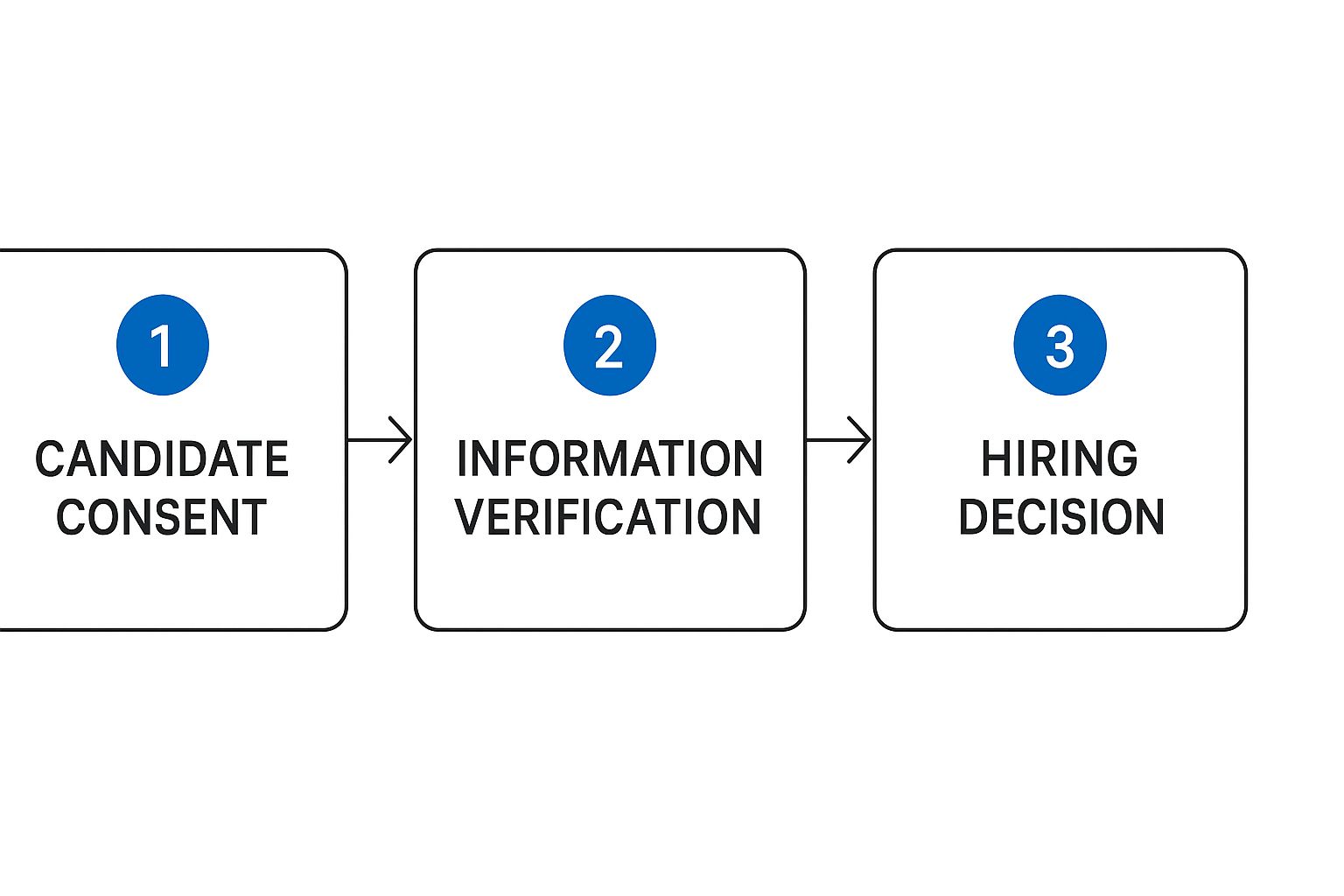
As you can see, a compliant and efficient process always kicks off with transparent candidate consent. This isn’t just a box to tick; it’s the legal and ethical foundation for everything that follows.
Look Beyond the Price Tag
I’ve seen it time and again: the cheapest option is almost never the best. A low price can easily mask painfully slow turnaround times, non-existent support, or a clunky, manual process that drains your team’s precious time. Instead of fixating on cost, you need to prioritise a vendor’s ability to deliver accurate results, fast.
When you’re in a demo, ask direct questions about their average TAT for different checks. A criminal record check, for instance, should be significantly faster than verifying a candidate’s employment history across several past jobs. A reliable vendor will give you clear, realistic timelines.
A vendor that saves you ₹500 per check but delays your hiring process by a week is costing you far more in lost productivity and competitive advantage. Speed and accuracy are the metrics that truly matter for a growing startup.
Integration and Technology are Key
In a startup, efficiency is the name of the game. Your small team simply can’t afford to get bogged down with manual data entry or switching between a dozen different platforms. This is precisely why a vendor’s tech stack, especially their API (Application Programming Interface), is so important.
A robust API allows the background check platform to plug directly into your Applicant Tracking System (ATS) or Human Resource Information System (HRIS). This creates a completely seamless workflow where you can:
- Initiate checks automatically: Kick off a background check with a single click right from your ATS the moment a candidate moves to the offer stage.
- Track progress in one place: See the real-time status of all your checks without ever having to leave your main HR software.
- Receive reports directly: Completed reports get automatically attached to the candidate’s profile, keeping everything organised and secure.
This kind of integration does more than just save time. It wipes out repetitive admin work, slashes the risk of human error, and gives you one single source of truth for your entire hiring pipeline.
Evaluate Their Reports and Compliance
Not all background check reports are created equal. Always ask for sample reports during your evaluation. A high-quality report is easy to scan, clearly flags discrepancies versus verified information, and provides the source details for all the data. It should be clean and concise, empowering your team to make quick, informed decisions.
Just as important is their handle on Indian law. You need to probe their understanding of the DPDP Act.
- How exactly do they get and manage candidate consent?
- What are their protocols for data security and storage?
- How do they manage data for international candidates if you plan on hiring remotely?
A vendor who stumbles over these questions is a major red flag. They should be more than just a data provider; they need to be your compliance partner, helping you navigate the legal maze of background screening. At the end of the day, your verification partner is an extension of your company—their diligence is a direct reflection of your own.
To help you stay organised during your search, use a structured checklist. This ensures you compare every potential partner using the same important criteria, moving beyond just the sales pitch.
Essential Vendor Evaluation Checklist
| Feature/Criteria | Vendor A | Vendor B | What to Look For |
|---|---|---|---|
| Turnaround Time (TAT) | Clear, realistic timelines for different check types. | ||
| ATS/HRIS Integration | Pre-built integrations with your current systems (e.g., Freshteam, Darwinbox). | ||
| DPDP Act Compliance | Strong, documented processes for consent and data handling. | ||
| Report Quality & Clarity | Easy-to-read reports that clearly highlight red flags. | ||
| Candidate Experience | A simple, mobile-friendly interface for candidates to submit info. | ||
| Customer Support | A dedicated account manager or responsive support team. | ||
| Pricing Structure | Transparent, all-inclusive pricing with no hidden fees. | ||
| Geographic Coverage | Ability to verify records across all Indian states and internationally if needed. |
By systematically filling out a checklist like this for each vendor, you can make a data-driven decision that aligns with your startup’s need for speed, compliance, and a great candidate experience. This methodical approach ensures your chosen partner will be a true asset, not a bottleneck.
Building Your Startup’s Screening Policy From Scratch

A great vendor is just one piece of the puzzle. Without a clear, documented, and consistently applied screening policy, even the best background checks can become ineffective—or worse, a source of legal risk. Your policy is the foundation of a fair and defensible hiring process. Think of it as the rulebook that ensures every candidate gets a fair shake and your decisions remain objective.
This isn’t about writing a massive, bureaucratic document that no one reads. For a startup, the policy needs to be lean, clear, and actionable. It should tackle three fundamental questions: Who do we check? What do we check for? And how do we handle the results?
Let’s break down how to build this critical document from the ground up.
Tiering Your Checks for Different Roles
It makes zero sense to run the same exhaustive, expensive checks on a summer intern as you would on your new Chief Financial Officer. Not every role in your startup carries the same level of risk or responsibility. A smart policy creates tiers for the verification process based on the job’s function.
This approach saves you money and time, focusing your diligence where it truly matters.
- Tier 1 (All Employees): This is your baseline for everyone, from interns to co-founders. It should cover the essentials to confirm identity and workplace safety. This typically includes Identity Verification (Aadhaar, PAN) and a Criminal Record Check.
- Tier 2 (Mid-Level/Customer-Facing Roles): For employees handling client relationships or company data, you’ll want to add another layer. This tier would include everything in Tier 1, plus Employment History and Education Verification to confirm their professional background.
- Tier 3 (Senior Leadership/Finance/IT): For roles with serious financial, strategic, or data security responsibilities, you need the highest level of scrutiny. This includes all previous checks, plus a Credit History Check and potentially a search of global regulatory and compliance databases.
Documenting these tiers brings consistency to your hiring and removes any guesswork.
Crafting Your Adjudication Matrix
This is arguably the most critical part of your screening policy. An adjudication matrix is a simple decision-making tool that helps you evaluate any red flags that pop up on a background report. It forces you to define, ahead of time, what findings are relevant to a specific job and what might be a deal-breaker.
This matrix is your best defence against inconsistent or biased decisions. It ensures you assess a finding based on the role’s actual requirements, not just a gut reaction.
A well-defined adjudication matrix shifts your hiring decision from a subjective judgement call to an objective, policy-driven evaluation. It’s the key to making fair and legally sound choices when you’re faced with a negative report.
For instance, a past financial hiccup might be a serious concern for a finance manager (Tier 3) but completely irrelevant for a junior graphic designer (Tier 1). Your matrix should capture this nuance. It should outline potential findings (like a criminal conviction or an employment discrepancy) and classify their severity (low, medium, high) for each role tier.
Standardising Consent and Candidate Rights
Your policy absolutely must formalise how you get and handle candidate consent, as required by law. Be specific: a clear, standalone consent form must be signed by the candidate before any checks are kicked off.
A fair policy also gives candidates a chance to respond to negative findings. This is often called the adverse action process. Your policy should state that if a report contains information that could lead to a negative hiring decision, you will:
- Notify the candidate and give them a copy of the report.
- Provide a reasonable amount of time (say, 5-7 business days) for them to review it and dispute any inaccuracies with the verification vendor.
This doesn’t just ensure fairness; it also protects you from making a bad decision based on incorrect information. Documenting these steps shows a commitment to transparency and is a cornerstone of responsible human resources management. By creating this structured framework, your startup can make hiring decisions that are not just smart, but also equitable and compliant.
The Different Types of Checks and When to Use Them
Not every role in your startup requires the same deep dive. A one-size-fits-all approach to background checks is a quick way to burn through your budget and slow down hiring. The real trick is to be smart about it, deploying different checks for different roles to build a relevant profile of each candidate.
Think of it as assembling a toolkit for each hire. For some roles, you just need the essentials. For others, particularly those with more responsibility, you’ll need a much more specialised set of tools. Let’s break down the common types of background checks for startups and figure out the right time to use each one.
Foundational Checks for Every Hire
A couple of checks are simply non-negotiable. These form the bedrock of a trustworthy team and should be standard for everyone you bring on board, from a senior developer to a part-time intern.
- Identity Verification: This is square one. Is the person actually who they claim to be? This check confirms their identity using government-issued documents like an Aadhaar or PAN card. Every other check you run is built on this foundation.
- Criminal Record Check: A search through police and court records is essential for flagging any criminal history. It’s a fundamental step in ensuring workplace safety and protecting your company, your team, and your customers.
Consider these two checks your baseline for establishing trust and safety.
Verifying Professional Credentials
Once you’ve confirmed identity and run a safety check, it’s time to verify what’s on the resume. This is where you can catch everything from minor exaggerations about job titles to completely fabricated work histories.
A candidate’s resume is a marketing document, not a sworn statement of fact. Verification is the process of turning their claims into verified information you can rely on to make a hiring decision.
Education Verification is crucial for roles where a specific qualification is a must-have. Think chartered accountants or data scientists with a specialised master’s degree. This check confirms that a candidate actually attended the university they listed and earned the degree they claim.
Employment History Verification is just as important. It validates dates of employment, job titles, and sometimes even a candidate’s eligibility for rehire from past employers. This helps you spot suspicious gaps in their timeline or inflated roles. For startups looking to handle this efficiently, understanding the details of professional employment verification is a great place to start.
Modern Checks for a Modern Startup
Beyond the traditional verifications, today’s startups can get a lot of value from more contemporary screening methods. These are especially handy for assessing things that don’t show up on a resume, like cultural alignment or potential reputational risks.
Social Media Screening, for instance, is becoming more common. This isn’t about digging into a candidate’s personal life. It’s a professional review of publicly available information to spot red flags like violent rhetoric, discriminatory behaviour, or sharing confidential information from previous jobs. When handled ethically by a third party to avoid bias, it can offer a valuable glimpse into a candidate’s public persona.
Indian startups have increasingly made background checks a standard part of their hiring. A recent report noted that many startups now routinely conduct verifications for criminal history, education, past employment, and identity. On top of these traditional checks, social media screening is being adopted to assess cultural fit and manage potential reputational damage. You can find more insights on how Indian startups are leveraging BGV.
By mixing and matching these different checks, you create a screening process that’s both robust and perfectly suited to the role you’re hiring for. This tailored approach means you’re gathering the right information to build a team that isn’t just skilled, but also trustworthy and aligned with your startup’s mission.
Common Founder Questions About Background Checks
When it comes to background checks for startups, I’ve found that founders often have the same practical questions. You get the “why,” but the “how” and “when” can feel a bit murky. Let’s walk through some of the most common queries I hear and get you some clear, actionable answers.
When Is the Right Time to Start Background Checks?
The best time? Before you hire your very first non-founder employee. I know, it sounds like overkill when your team can fit in a single car, but starting early sets a professional and secure standard from day one. It’s so much easier to implement a policy when you’re small than to introduce it later to an established team who might see it as a sign of mistrust.
If you’re worried about the budget, you don’t need to go all-in with a multi-layered check for your first few hires. Start with the absolute must-haves, like identity verification and criminal record checks. As your startup grows and you start handling more sensitive client or company data, you can expand the scope of your screening. The key is to have a formal, written-down process in place before you’re in a situation where you desperately need one.
What if a Great Candidate Fails a Background Check?
This is exactly why having a pre-defined adjudication process is non-negotiable. Don’t jump to conclusions. Your first move should always be to give the candidate a chance to explain what’s going on. Sometimes, it’s a simple misunderstanding or a clerical error in the public records that they can clear up quickly.
Next, you have to look at the finding purely through the lens of the job they’re applying for.
- For a CFO role: A history of financial mismanagement or a significant credit default is obviously a huge red flag.
- For a graphic designer role: That same financial issue? It’s probably completely irrelevant to their ability to do the job.
Always, always document how you made your decision. This makes your final choice objective, fair, and legally sound, protecting your startup from any potential claims of bias. This is about assessing relevant risk, not making a moral judgement.
A failed check isn’t an automatic rejection. Think of it as a signal to follow your fair, predefined process. Give the candidate a chance to respond and weigh the flag against the specific risks of that particular job.
Can We Run Background Checks on Current Employees?
Tread very carefully here. This is a sensitive topic and requires a delicate touch. Generally, you need a strong and legitimate business reason to screen someone who is already on your payroll. A classic example is when an employee is moving into a role with much higher responsibility—like a position that gives them financial authority or access to critical data infrastructure.
Crucially, under India’s DPDP Act, you must get their explicit and fresh consent before you do anything. You can’t just rely on the consent they gave you when they were first hired years ago. A transparent way to handle this is to build the check into your promotion policy. This way, accepting the new, higher-risk role implicitly includes consenting to an updated background check. Trying to run checks retroactively without a clear reason and new consent is a surefire way to cause serious legal and morale problems.
Are Social Media Checks a Good Idea for Startups in India?
Yes, they can be a useful tool, but only if you approach them ethically and strategically. Social media screening is perfectly legal as long as you’re only reviewing publicly available information and you’ve gotten the candidate’s consent as part of your overall screening policy.
The big risk here, however, is unconscious bias. Your policy needs to be incredibly clear about what you are looking for. The aim is to spot genuine workplace risks, such as:
- Threats of violence or clearly discriminatory language.
- Sharing confidential information from previous jobs.
- Evidence of illegal activity.
You are not screening for their personal beliefs, political views, or lifestyle choices. To sidestep these landmines, I strongly recommend using a third-party vendor for this check. They can apply objective, pre-set criteria and filter out any information related to protected characteristics. This stops your hiring managers from being swayed by unconscious bias while scrolling through profiles and keeps the entire process fair and focused on legitimate business concerns.
Ready to build a trustworthy team with confidence? SpringVerify provides reliable and comprehensive background verification services designed for fast-growing startups in India. Our seamless API integrations and commitment to data security make informed hiring faster and more efficient. Learn more and get started today.


