

Hiring a new employee is a massive investment in your company’s future. But how can you be sure you’re making a sound one? Think of a background check service as your essential due diligence tool. For Indian businesses, it’s the process of verifying a candidate’s history to protect your company’s reputation, culture, and assets. It’s your first and most important line of defence against hiring risks.
Table of Contents
Why Background Checks Are Crucial for Your Business
Hiring someone without a background check is a bit like agreeing to a major business partnership based only on a flashy presentation. A candidate’s resume and a great interview can paint a compelling picture, but they rarely tell the whole story. A professional background check digs deeper, confirming that the person you’re considering is exactly who they claim to be. This isn’t just a “nice-to-have” anymore; it’s a strategic necessity.
This verification process builds a foundation of trust and safety right from the start. This is especially true for businesses expanding their workforce remotely. If you’re in that boat, understanding the full hiring process is key, and this comprehensive guide on how to hire remote employees offers some fantastic insights. By confirming credentials and screening for potential red flags, you’re creating a more secure work environment for everyone.
Protecting Your Company from Within
It’s an uncomfortable truth, but internal threats can often be far more damaging than external ones. A thorough screening process is fundamental to heading off risks like internal fraud, data theft, and workplace misconduct before they have a chance to take root. When you take the time to verify a candidate’s past, you’re actively safeguarding your company’s most valuable assets: its people, its data, and its hard-won reputation.
The benefits of a solid background check programme are tangible and far-reaching:
- Prevents Internal Fraud: Verifying past employment and checking for criminal history can be a powerful deterrent for individuals with a history of deceitful behaviour.
- Fosters a Culture of Trust: When your team knows that everyone has been vetted to the same high standard, it builds a much stronger, more cohesive workplace.
- Ensures a Safer Work Environment: Screening helps you identify individuals who might pose a threat to the safety and well-being of your current employees.
Acknowledging the Rise in Employment Fraud
Unfortunately, twisting the truth on resumes and in interviews is a growing problem. The world of employment fraud has become more complex, particularly with the rise of digital hiring scams making it easier to fabricate credentials. A recent EY study drives this point home, highlighting that employment frauds have surged significantly and calling for more tech-enabled vigilance in hiring. The report revealed a startling statistic: in the healthcare sector, 96% of offenders were experienced professionals, proving that risk isn’t just limited to entry-level roles. You can read more about these findings on employment fraud on EY.com.
By proactively verifying a candidate’s history, you are not just filling a role; you are building a resilient and trustworthy organisation from the ground up, one hire at a time.
Exploring the Types of Employee Background Checks
A thorough background check isn’t just a single search; it’s a multi-layered investigation. Think of it like putting together a puzzle. Each type of check is a unique piece, and only when you assemble them do you get a clear, complete picture of a candidate. This allows you to build a screening programme that’s both effective and cost-efficient for your organisation.
Each verification type targets a specific business risk, going beyond a simple checklist to answer the “why” behind the search. This way, you gather the most relevant information for any given role, whether you’re hiring an entry-level employee or a senior executive.
The benefits are undeniable. A comprehensive check helps companies hire faster, minimise risk, and ultimately, build a higher-quality workforce.
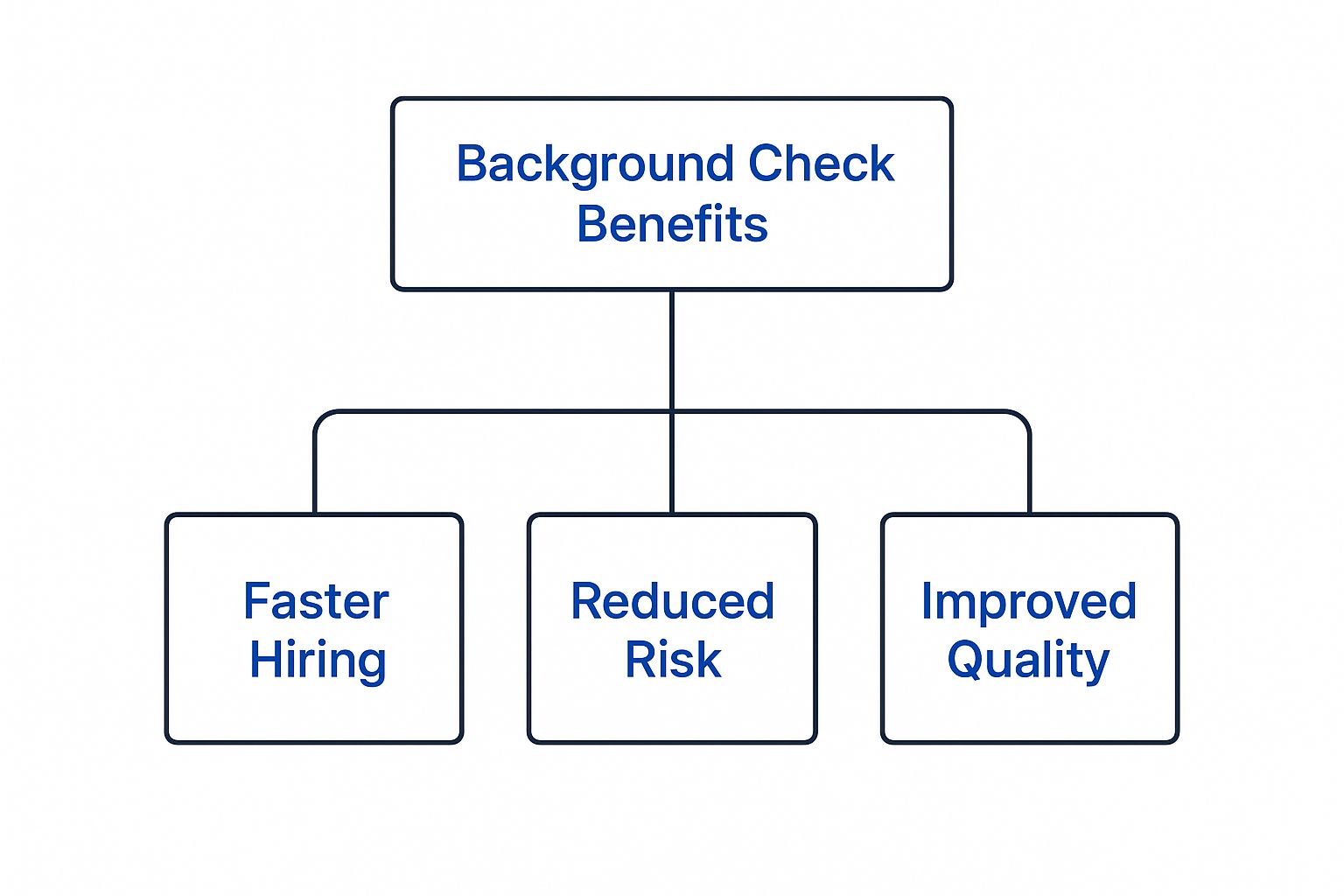
As you can see, a well-structured background check service directly supports key business goals, creating a more secure and efficient hiring process from start to finish.
To help you understand the different “puzzle pieces” available, here’s a quick overview of the most common types of checks employers use.
Overview of Common Background Check Types
| Type of Check | What It Verifies | Primary Purpose |
|---|---|---|
| Criminal Record | Past felony or misdemeanour convictions from local, state, and national databases. | To ensure workplace safety and protect the company, customers, and other employees. |
| Employment History | Previous employers, job titles, and dates of employment as listed on a CV. | To prevent resume fraud and confirm a candidate’s professional experience is legitimate. |
| Education & Credentials | Degrees, certifications, and professional licenses from academic and professional institutions. | To confirm a candidate has the required qualifications for technical, medical, or other specialised roles. |
| Reference Checks | Qualitative insights into a candidate’s work ethic, skills, and team collaboration. | To gain a real-world perspective on a candidate’s performance and character from former colleagues. |
| Address Verification | Current and past residential addresses. | To establish and confirm a candidate’s identity as a foundational verification step. |
| Credit History | Financial stability and integrity through a review of credit reports. | To assess risk for roles with significant financial responsibility, like accounting or management. |
| Global Database & Sanctions | Presence on international watchlists, such as terrorist and sanctions lists. | For global companies and roles in highly regulated industries to ensure compliance and security. |
Now, let’s take a closer look at what each of these checks involves and why it might be crucial for your next hire.
Criminal Record Verification
This is what most people think of when they hear “background check,” and for good reason. A criminal record check scans various databases—local, state, and national—to find any past felony or misdemeanour convictions. It’s a fundamental step for creating a safe workplace.
For roles that involve finance, handling sensitive data, or working with vulnerable people like children, this check is an absolute must. It’s your first line of defence to protect your customers, your current team, and your company from potential misconduct or harm.
Employment History Verification
A candidate’s resume is designed to showcase their best side, but it’s vital to confirm the details. Employment verification confirms the basics: previous employers, job titles, and employment dates. This check is your number one tool for catching resume fraud.
It’s all about spotting inconsistencies and making sure a candidate’s claimed experience is real. This is so important because discrepancies are far more common than most employers think. For a deeper look into this specific area, you can learn more about our professional employment history verification service.
Education and Credential Confirmation
When a job requires a specific degree, certification, or professional licence, this check is non-negotiable. Education verification confirms that a candidate actually earned the credentials they claim from legitimate institutions.
This is critical for technical, medical, or legal roles where specific knowledge is a prerequisite for doing the job correctly. It ensures you’re hiring someone with the proven expertise to succeed, helping you avoid the serious risks that come with hiring an unqualified person.
Other Important Verification Types
Beyond these core three, several other checks can offer valuable insights, depending on the role you’re filling:
- Reference Checks: This is where you get the story behind the CV. Speaking with a candidate’s former managers or colleagues provides qualitative insight into their work ethic, team skills, and overall performance.
- Address Verification: A simple but essential check. It confirms a candidate’s current and past addresses, which is a foundational part of establishing their identity.
- Credit History Checks: For roles with major financial responsibility, a credit check can offer a glimpse into a person’s financial integrity. To understand how this information is put together, you can explore a guide to all three major credit bureaus.
- Global Database and Sanctions Checks: This check scans international watchlists, including terrorist and sanctions lists. It’s crucial for global companies or roles in highly regulated industries where compliance is paramount.
Navigating the Legal Landscape in India
Using a background check service in India isn’t just about digging up information; it’s about doing it legally and ethically. The rules around employee verification can seem complicated, but getting them right is non-negotiable for protecting your business and respecting a candidate’s rights.
Think of it as the rulebook for the hiring game. Playing by it keeps things fair and keeps you out of hot water.
The single most important rule is explicit candidate consent. You absolutely must get clear, written permission from an applicant before you start any check. This isn’t a friendly suggestion—it’s a hard legal requirement. The consent form needs to be transparent, spelling out exactly what information you intend to verify.
The Cornerstone of Consent and Privacy
Consent is the very foundation of a compliant background check process. A candidate has to knowingly agree to the verification, and you need to document that agreement properly. This simple step is your first and best defence against any legal claims of privacy invasion.
But it doesn’t stop with consent. How you manage the data you collect is just as critical. India’s Information Technology (IT) Act, 2000, and the IT Rules of 2011, currently set the stage for data protection. These laws define personal details like financial records, medical history, and biometrics as “sensitive personal data.”
Once you collect sensitive information through a background check service, your organisation is legally on the hook for protecting it. That means you need solid security measures in place to stop anyone from accessing, changing, or sharing it without permission.
This responsibility is only getting stricter with the new Digital Personal Data Protection Act, 2023. Keeping up with these regulations is essential. To dive deeper, you can explore more about staying compliant with Indian hiring laws and make sure your processes are always airtight.
Fair Use and Making Objective Decisions
So, you’ve got the background check report. What’s next? The crucial step is interpreting the findings fairly. The information should only be used to judge if a candidate is a good fit for that specific role. It’s vital to avoid letting biases or irrelevant details cloud your judgement.
For example, a past financial hiccup might be a major red flag for a Chief Financial Officer role, but it’s probably meaningless for a graphic designer position. This is where an adjudication matrix comes in handy. It’s a tool that helps you create clear, consistent rules for evaluating findings based on what a particular job actually requires.
This structured approach makes sure your hiring decisions are:
- Objective: Based on clear criteria directly tied to the job’s duties.
- Consistent: Applied the same way for all candidates in similar roles.
- Defensible: You have a solid, logical reason for your decision if it’s ever challenged.
Costs and Timelines for Checks in India
The cost and time for a background check naturally depend on how deep you need to go. With no single, overarching law for BGV, these checks are becoming even more important for maintaining a trustworthy workforce.
A basic check, usually covering education and past employment, often costs between ₹500 and ₹1,000 and takes about three to five days. More thorough checks, which might include criminal records and detailed reference interviews, can run from ₹2,000 to ₹3,000 and take up to ten days. Industries like IT, BFSI, and healthcare rely heavily on these to prevent fraud and meet tough regulatory standards.
By putting consent first, protecting data, and evaluating information fairly, you can build a verification process that’s not just effective but also legally sound and respectful to every candidate. It’s an approach that builds trust and cements your reputation as an employer who does things the right way.
How to Choose the Right Background Check Partner
Choosing a background check provider isn’t just about buying a service; it’s about finding a strategic partner. Think of them as a gatekeeper for your company’s talent, integrity, and safety. It’s tempting to just look at the price, but you need to dig deeper to find a service that truly fits your industry, size, and risk appetite.
Making the right call means sizing up potential vendors on a few critical fronts. How good is their technology? How accurate are their results? How fast can they get reports back to you? And how well do they understand compliance? The real goal is to find a partner who gives your hiring team reliable, clear insights they can act on.
Evaluating Technology and Platform User-Friendliness
In today’s fast-moving hiring world, efficiency is everything. Any modern background check service worth its salt should be built on a powerful, easy-to-use tech platform. A clunky or confusing interface is more than just an annoyance—it creates bottlenecks, frustrates your HR team, and can slow down your hiring.
Look for a platform with a clean, intuitive dashboard. Can you kick off checks, see their progress in real-time, and pull up finished reports without a headache? The best platforms are designed to make the whole process feel effortless for your team.
A provider’s technology is a direct reflection of their commitment to efficiency and accuracy. A platform that automates repetitive tasks and provides clear, real-time updates empowers your HR team to focus on what matters most—making great hires.
Another make-or-break feature is integration capability. A top-tier service will have a robust API that can plug straight into your existing Human Resource Information System (HRIS) or Applicant Tracking System (ATS). This isn’t just a nice-to-have; it’s a game-changer. Integration automates the entire verification workflow, gets rid of manual data entry, and slashes the risk of errors. If you want to dive deeper, our guide to improving your entire talent acquisition process offers some great strategies.
Accuracy and Turnaround Time
When you boil it all down, the two things that matter most are accuracy and speed. An inaccurate report is actually worse than having no report at all—it could lead you to make a bad hire or, just as bad, unfairly pass on a fantastic candidate. And in a tight job market, a slow report means you could lose your top choice to a faster-moving competitor.
You should directly ask potential vendors about their accuracy rates and their average turnaround time (TAT) for the specific checks you’ll be running. A transparent partner will be upfront with these numbers and will have solid processes to back them up.
To really understand what a provider can do, try asking these questions:
- What’s your standard process for verifying information from different sources?
- How do you resolve discrepancies or conflicting information you find?
- What is your typical turnaround time for employment and education verifications?
- Do you give real-time status updates on checks while they’re in progress?
Compliance Expertise and Support
Navigating the legal landscape of background checks in India is no simple task. Your partner absolutely must have deep expertise in Indian data privacy laws and hiring regulations. Their knowledge is your best defence against legal trouble down the road.
They should be able to show a solid grasp of consent requirements and data security protocols. A compliant provider will help you build a screening process that is both fair and legal. Just as important is the quality of their customer support. When you have a question or an issue pops up with a report, you need to know you can reach a responsive, knowledgeable person who can give you clear answers and fix the problem quickly.
Evaluating Background Check Service Providers
To make the right choice, you need a clear framework for comparing your options. This table breaks down the essential criteria to help you find a partner that fits your needs perfectly.
| Evaluation Criterion | What to Look For | Why It Matters |
|---|---|---|
| Technology & API | An intuitive platform and seamless integration with your existing HR systems (HRIS/ATS). | A modern, integrated platform saves your HR team valuable time and reduces manual errors. |
| Accuracy Rate | A proven track record of delivering precise and reliable verification reports. | Inaccurate information can lead to poor hiring decisions and significant business risk. |
| Turnaround Time | Fast and predictable delivery times for all types of background checks. | Slow reports can result in losing top candidates to competitors in a fast-moving job market. |
| Compliance & Support | Deep knowledge of Indian legal requirements and accessible, expert customer service. | Ensures your hiring process is legally sound and provides peace of mind when issues arise. |
At the end of the day, picking the right background check service is an investment in your company’s future. By taking the time to evaluate these key areas, you can choose a partner that doesn’t just deliver accurate data but acts as a trusted extension of your HR team.
Building Your Internal Verification Process
Picking the right background check partner is a great start, but the real success of your screening programme comes down to having a solid, consistent internal process. It’s not just about being efficient. How you weave these checks into your hiring workflow says a lot about your company’s professionalism, fairness, and the kind of experience you want candidates to have.
Think of your internal process as the operating system for your background checks. A top-notch background check service delivers the data, but your process is what turns that data into smart, defensible hiring decisions. When setting this up, borrowing ideas from a structured franchise recruitment process, which is built on thorough vetting, can be incredibly helpful.
Develop a Formal Background Check Policy
First things first: get it in writing. A formal, documented policy is your rulebook. It gets everyone on the hiring team singing from the same hymn sheet, removing any guesswork and ensuring consistency for every single hire.
To be truly effective, your policy needs to clearly lay out a few key things:
- When to Screen: Pinpoint the exact stage you’ll run checks. For most companies, this happens right after a conditional job offer is made.
- Who Gets Screened: Be specific about which roles need which checks. A cashier probably doesn’t need a global sanctions check, but you’d absolutely want one for a senior finance executive.
- What You Screen For: List the exact verifications you’ll conduct for different job levels or departments (e.g., criminal, employment, education).
This documented framework moves your process from improvised to systematic—a crucial step for both compliance and operational smoothness. It’s about protecting the company and treating every candidate fairly.
Communicate Transparently with Candidates
Honesty is the best policy, especially here. Candidates have a right to know you’re conducting a check, and being upfront about it makes the whole thing feel less like an interrogation and more like a standard professional step.
Keep your communication simple and direct. Let candidates know that a background check is a required part of the process and, critically, get their explicit written consent before you start. This isn’t just good manners; in India, it’s a legal requirement. A straightforward consent form explaining the scope of the check is absolutely non-negotiable.
A transparent process respects the candidate and reinforces your company’s commitment to fair and ethical hiring practices. It sets a professional tone from the very beginning of your relationship with a potential new employee.
Establish a Fair Adjudication Process
So, what do you do when a report comes back with a “red flag”? This is where your adjudication process kicks in. It’s your structured framework for looking at adverse information fairly and objectively, without jumping to conclusions.
A knee-jerk reaction to a discrepancy is a recipe for legal and ethical headaches. A fair process gives the candidate a chance to tell their side of the story. This not only leads to a better-informed decision but also massively reduces your legal risk.
Your adjudication process should follow these key steps:
- Review the Findings: A designated person or committee should review the issue in the context of the job. Is this finding actually relevant to the candidate’s ability to do the work?
- Notify the Candidate: Before making any negative decision, you must inform the candidate about the specific information that’s causing concern.
- Allow for a Response: Give them a reasonable amount of time to explain or dispute the findings. It could be a simple misunderstanding, a clerical error, or even a case of mistaken identity.
- Make a Final Decision: Once you’ve considered all the information, including the candidate’s input, make a final, non-discriminatory hiring decision based on your predefined policy.
By putting these steps in place, you create an internal verification system that not only works for your HR team but also ensures a professional and respectful experience for every candidate, even when difficult findings arise.
The Future of Employee Screening Technology

The world of employee verification is changing fast. The old way of doing things—manually chasing down credentials and references—is being replaced by smarter, faster, and more powerful technologies. For any organisation in India, staying on top of these shifts isn’t just a good idea; it’s essential for building a modern and effective hiring strategy.
At the very heart of this evolution are Artificial Intelligence (AI) and Machine Learning (ML). Think of them as a hyper-efficient assistant for your HR team. They can analyse huge volumes of data in seconds, a job that would otherwise take a human team hours, if not days. This automation is a game-changer for speeding up the entire verification process.
For example, AI-driven tools can now scan and verify documents like identity cards or educational certificates in a flash, flagging potential forgeries or inconsistencies with a level of precision that’s simply not humanly possible. This frees up your team to move much faster and with a lot more confidence.
The Rise of Automation and Deeper Insights
But the impact of AI isn’t just about speed. These advanced systems are trained to spot patterns and anomalies that might easily slip past a human reviewer, which significantly boosts the accuracy of every single check. When you’re trying to build a workforce you can trust, that’s a massive advantage.
This new wave of technology is making several key advancements a reality:
- Faster Document Analysis: AI algorithms can pull and cross-reference information from different documents almost instantly. This cuts turnaround times from days down to mere hours.
- Improved Accuracy: Machine learning models are constantly learning from millions of data points, getting better and better at spotting discrepancies and confirming details correctly.
- Deeper Digital Footprint Analysis: Modern tools can help analyse a candidate’s public online presence—compliantly, of course—offering insights into their professionalism that you’ll never find on a standard CV.
The goal is no longer just to confirm what’s on a resume but to gain a more complete and reliable picture of a candidate, all while respecting data privacy and legal boundaries.
Blockchain and Secure Credentials
If we look even further into the future, an incredibly exciting development is the potential of blockchain technology. Picture a world where professional credentials, like university degrees or work certifications, are stored as secure, unchangeable digital records.
This would essentially create a single, undisputed source of truth for a candidate’s qualifications. A person could simply grant a potential employer temporary access to their verified credentials, completely getting rid of the need for those time-consuming verification calls to universities and past employers. This approach points to a future where verifications are instant, totally secure, and put the individual in control of their own data.
While it’s still an emerging concept, blockchain represents a fundamental shift in how we think about professional identity.
By embracing these technological leaps, your organisation can not only make your hiring process far more efficient but also gain a serious competitive edge. A forward-thinking background check service will be the one that integrates these tools to give you deeper insights, quicker results, and a higher level of assurance, placing your company at the forefront of modern recruitment.
Frequently Asked Questions About Background Checks
As you start to weave a background check service into your hiring process, a few practical questions are almost certain to pop up. This section gets straight to the point, answering some of the most common queries we hear from HR managers and business owners across India.
Think of this as your go-to guide for navigating the specifics—from timelines to tricky findings—so you can run your verification process with confidence.
How Long Does a Typical Background Check Take in India?
The turnaround time really depends on what you’re checking. For a basic check, like confirming someone’s identity and address, you’re looking at a pretty quick timeline—usually just 1-3 business days.
But if you need a more thorough look, including deep dives into employment history, educational degrees, and criminal records, it naturally takes a bit longer. For these comprehensive checks, you should plan for about 5 to 15 business days. The biggest factor here is often how quickly past employers or universities get back to us with the information.
Is Candidate Consent Mandatory for a Background Check?
Yes, without a doubt. In India, getting explicit, written consent from a candidate before you start a background check is a legal and ethical must. There’s no grey area here. It’s fundamental for complying with privacy laws and, just as importantly, for respecting the candidate’s rights.
Your consent form needs to be crystal clear. It should spell out exactly which checks you’ll be running. This kind of transparency isn’t just a legal formality; it builds trust right from the get-go.
What Should We Do if a Discrepancy Is Found in a Report?
Finding a “red flag” or a discrepancy on a report can be stressful, but it’s vital not to jump to conclusions. The first step isn’t to reject the candidate—it’s to follow a fair and consistent process.
Reach out to the candidate and give them a chance to explain or provide clarifying details. Sometimes, it’s a simple misunderstanding. Always follow your company’s predefined policy to investigate further before making a final, non-discriminatory hiring decision.
Ready to make your hiring process faster, safer, and more reliable? SpringVerify offers prompt, accurate, and seamless background verification services designed for Indian businesses of all sizes. Discover how our background check service can protect your business today!


