

Table of Contents
Navigating The Indian ATS Integration Landscape
The way companies hire in India has changed quite a bit, with more businesses using technology to find the best people. For companies that want to do well, getting ATS integration sorted is no longer just an option—it’s essential. This is a key step because old-fashioned hiring methods often don’t work well and can mean missing out on great candidates in a busy job market.
Trying to hire in India using outdated methods can cost a lot, not just in money, but also in time and the quality of people you find. Think about manually looking through thousands of ‘biodatas’; it’s like searching for one specific grain of rice in a giant sack. This old approach can leave your company behind, while others who have adopted ATS integration are already connecting with top talent.
Addressing Unique Challenges in the Indian Market
One of the biggest hurdles for Indian companies is the sheer volume of applications they receive. For any popular job, especially in big cities, recruiters can be swamped with an enormous number of CVs. Good ATS integration works like a smart filter, helping to manage this flood of applications effectively.
Another challenge is the variety of languages used across India. Many candidates might send applications or resumes in regional languages. Standard Applicant Tracking Systems, especially those made for Western countries, might not be able to process these multilingual documents properly. This is where ATS solutions designed for India or those that can be adapted become really useful.
Smart ATS integration helps solve these problems directly, making your hiring process much more efficient. The use of Applicant Tracking Systems in India has significantly increased over the years due to the growing challenges in recruitment. The demand for ATS became particularly noticeable around the period leading up to 2025, as companies faced intense competition for skilled individuals. For example, systems like Zappyhire and Zoho Recruit are popular choices for Indian businesses, providing AI-driven recruitment automation and solutions aimed at small to medium-sized enterprises (SMEs). You can discover more insights about top ATS solutions in India by researching current market offerings.
Beyond Basic Application Management: Strategic Talent Acquisition
Effective ATS integration involves more than just setting up software; it means making it a core part of your overall talent acquisition plan. The real value comes when the system is thoughtfully put in place and connects smoothly with your other HR tools, rather than just sitting unused. Leading companies in India are using these systems for more than just sorting applications; they’re building a strong pipeline of potential hires.
These forward-looking organizations employ ATS integration to develop a more complete hiring strategy. This includes improving how they communicate with candidates, making decisions based on data, and staying compliant with local laws. By linking their ATS with other HR technologies, they create a powerful setup. You can check out available guides on how API integrations can help create a smooth HR workflow. This approach turns the ATS from a simple database into an active tool for attracting and keeping the best talent.
Unlocking AI-Powered ATS Integration For Indian Companies
Artificial intelligence (AI) isn’t just science fiction anymore; it’s truly changing the game for forward-thinking Indian companies and how they find new talent. When AI is combined with a smart Applicant Tracking System (ATS) integration, it adds a whole new level of intelligence. This makes the entire hiring process much more efficient, which is a big deal for businesses trying to attract top employees in today’s busy job market.
The AI Advantage in Recruitment
So, how exactly does an AI-boosted ATS integration make a difference? It’s all about making the journey of managing job applications smoother and smarter for Indian businesses. This isn’t just about speeding things up; it’s about weaving intelligent features right into the daily tasks of recruiting.
One of the first things you’ll notice is a big improvement in how applications are handled from the get-go. Take automated resume screening, for example. Imagine your HR team no longer having to manually read every single one of the hundreds, or even thousands, of ‘biodatas’ (resumes) that come in for a job opening. Instead, AI can intelligently scan and rank these CVs in just a few minutes – a massive help in India where popular jobs get a huge number of applicants.
Beyond just screening, advanced candidate matching algorithms are a real asset. These smart systems can be tailored to get the hang of India’s unique and varied job scene. They help pinpoint candidates who don’t just have the necessary skills but also seem like a good fit for the company’s vibe, even when searching through massive pools of talent.
Key Benefits for Indian HR Teams
The perks of AI don’t stop at just processing applications; they reach right into the core strategic work of HR. For instance, AI-driven predictive analytics can give HR teams a clearer picture of hiring patterns and even help guess what kind of talent they’ll need in the future.
This lets Indian companies be more forward-thinking with their hiring strategies. They can spot possible skill shortages or up-and-coming in-demand roles well before they become a pressing issue.
With AI handling many of the tedious, manual jobs, HR professionals find themselves with more time on their hands. This means your team can switch from being bogged down by paperwork to focusing on more impactful tasks. Think deeper candidate conversations, building a stronger employer brand, and careful succession planning.
This change is incredibly important, particularly for HR teams in India who are often juggling many tasks with tight budgets and resources.
To give you a better idea of how these AI features are being implemented, here’s a comparison of capabilities you might find in some leading Applicant Tracking Systems used by Indian companies. This table outlines common AI-driven functionalities.
AI Features Comparison in Popular Indian ATS Platforms
Detailed comparison of AI capabilities across leading ATS solutions used by Indian companies
| Platform | AI Resume Screening | Candidate Matching | Predictive Analytics | Bias Reduction Features |
|---|---|---|---|---|
| HireSmart India | Advanced (NLP-based parsing, keyword & contextual analysis) | Good (Skill & experience based) | Yes (Basic trend reporting) | Basic (Anonymous screening option) |
| TalentFlowPro | Yes (Standard keyword screening) | Advanced (AI-powered skill, culture & potential fit) | Limited (Dashboard metrics) | Yes (Bias detection warnings) |
| RecruitNext AI | Comprehensive (Deep learning for nuanced understanding) | Comprehensive (Multi-factor matching including soft skills) | Advanced (Forecasting talent supply & demand) | Advanced (Proactive de-biasing suggestions) |
| KarmaHire ATS | Basic (Keyword extraction) | Yes (Role-based suggestions) | No | Partial (Manual review flags) |
| PeoplePrime AI | Good (AI-assisted ranking) | Good (Smart filtering options) | Yes (Recruitment funnel analytics) | Yes (Standardized evaluation templates) |
As you can see, while specific features vary, the trend is towards incorporating AI to automate screening, improve matching, provide data-driven insights, and promote fairer hiring. Choosing the right platform depends on a company’s specific needs and scale.
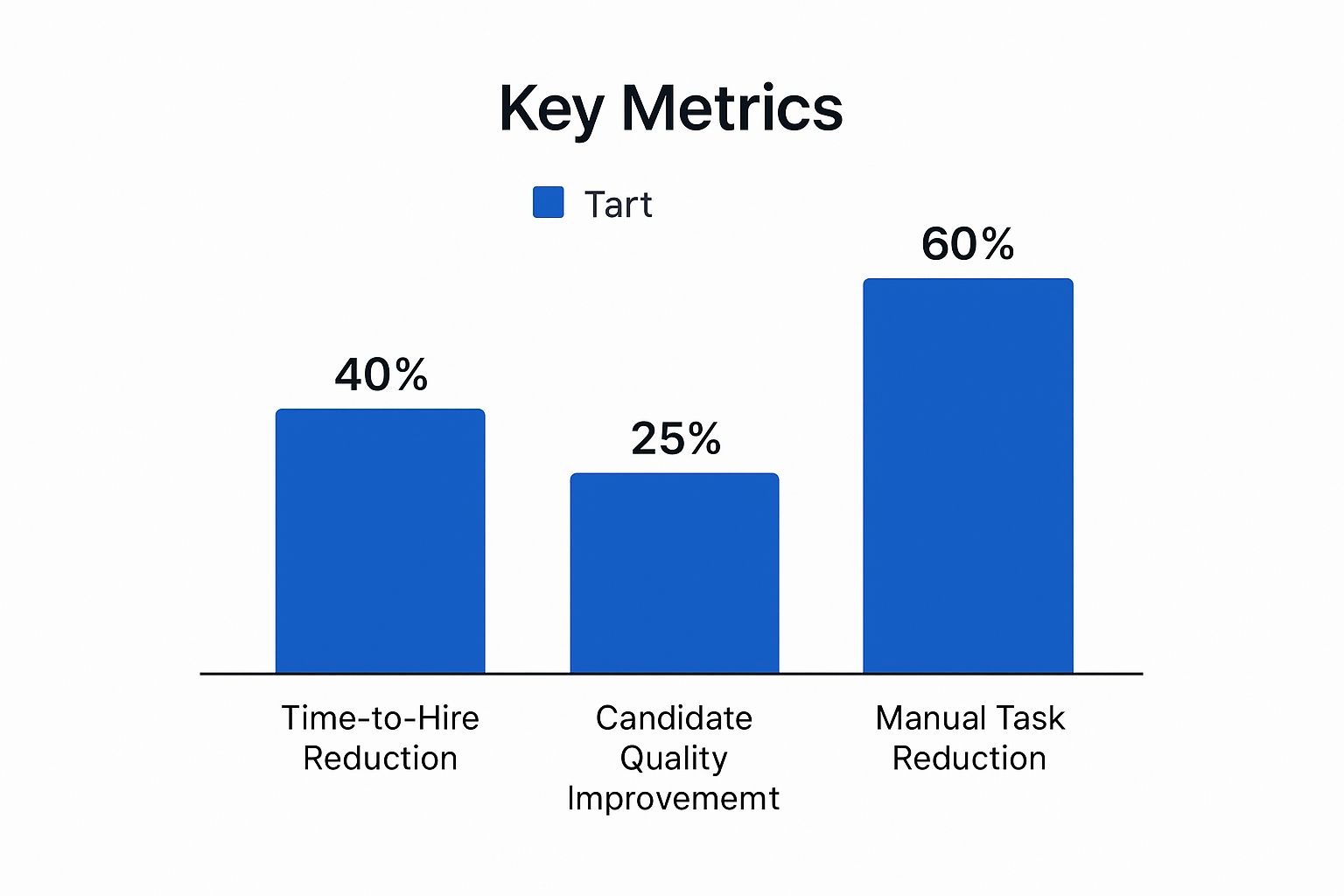
As the image shows, the numbers speak for themselves. AI can seriously slash hiring times by 40%, improve the quality of candidates you find by 25%, and cut down on those manual HR chores by a whopping 60%.
Driving Quality and Fairness in Hiring
But AI’s role isn’t just about speed; it’s also a powerful tool for improving who you hire and making the process fairer. By making the first look at applications consistent, AI can be a big help in reducing hiring bias. This means candidates are judged more on their skills and how well they fit the job, not on unconscious assumptions, leading to a richer mix of talented people.
Indian companies using AI in their ATS integration are right in step with what’s happening worldwide. It’s a clear global shift: statistics show that by 2024, 79% of organizations around the world had already brought AI or automation into their ATS. Out of these, 64% were using such tools specifically to help sort and filter candidates. You can find more detailed statistics on ATS usage here.
This clearly shows that hiring is becoming smarter and more reliant on data everywhere.
This move towards more strategic HR work, thanks to AI, is essential for a company’s growth and how it manages its talent. If you’re interested in diving deeper, you can learn more in our article about how to master modern talent acquisition.
Proactive Indian businesses are keenly embracing these AI features, not just to make their hiring smoother but also to keep up the high quality their operations require. For companies in India ready to tap into these benefits, there are many AI tools to consider. It’s interesting to note that AI’s usefulness isn’t limited to recruitment; for instance, AI-powered reception solutions like Mya AI Front Desk can also make tasks like managing a front desk much simpler.
Ultimately, incorporating AI into your ATS integration can lead to big wins in hiring and help build a more robust and skilled workforce for the future.
Capitalizing On Asia-Pacific ATS Growth Opportunities
The Asia-Pacific (APAC) area is seeing a significant increase in the use of Applicant Tracking Systems (ATS), with India playing an important role in this shift. For companies in this region, adopting these systems is more than just following a trend; it’s becoming crucial for staying competitive and ensuring future expansion. Effective ATS integration is now fundamental to successful talent acquisition plans throughout APAC.
This quick uptake is not accidental. A combination of related elements is paving the way for ATS integration to become widespread, prompting businesses to reconsider their approaches to hiring.
Factors Fueling the ATS Surge in Asia-Pacific
The movement towards contemporary recruitment tools is driven by several important changes:
- Increased Digitalization: Businesses throughout APAC, India included, are quickly adopting digital instruments. This shift naturally affects HR operations, where ATS platforms are at the forefront of automating and improving recruitment.
- Growing Workforce Needs: Numerous APAC nations are seeing economic progress, resulting in larger workforces and more job applicants. Handling this increased volume by hand is impractical, making ATS integration vital for effective candidate management.
- Changing Recruitment Demands: The need for specialized talents and quicker hiring processes is straining older recruitment techniques. Companies now look for advanced tools to find, attract, and onboard leading candidates quickly, a requirement that ATS solutions fulfill.
This active setting means that companies quick to implement solid ATS integration are already seeing considerable advantages. They are making their hiring processes more efficient, enhancing the caliber of their new employees, and using data to make informed choices for securing top talent.
Gaining a Competitive Edge with Strategic ATS Integration
Businesses that take the initiative to set up efficient ATS integration are achieving a notable competitive edge. For example, they can shorten their time-to-hire, a critical factor in rapidly changing sectors. Furthermore, a properly integrated ATS aids in developing a robust talent pool, preparing companies for upcoming hiring requirements.
In contrast, organizations that continue to use old-fashioned, manual hiring methods often have difficulty keeping up. They encounter issues such as extended hiring periods, greater administrative loads, and an increased chance of losing out on high-quality candidates. This difference underscores why ATS integration is shifting from an optional improvement to an essential tool.
The Asia-Pacific region, with India as a part of it, is seeing fast expansion in the ATS market. Projections indicate this market will grow by 8.4% in the next seven years, fueled by the previously mentioned digitalization and workforce growth. You can discover more about this trend on Mindk.com. This expansion highlights the substantial opportunities for businesses ready to adopt modern recruitment technologies. For companies in India, recognizing these regional patterns and using them through thoughtful ATS integration can open up considerable possibilities, enabling them to not only participate effectively but also take a leading position in attracting talent.
Building Your Strategic ATS Integration Roadmap
Adding an Applicant Tracking System (ATS) integration to your company isn’t just about buying software and hoping for the best. Think of it like drawing up blueprints before starting construction; a solid plan is essential. This careful preparation makes sure the new system truly works for your company’s specific requirements and team culture, which is particularly important in a varied business setting like India.
Laying the Foundation: Essential Preparation Steps
So, where do you begin? Before looking at any ATS options, it’s wise to carry out a detailed recruitment process audit. This involves a close examination of how you hire right now. For example, how are you managing the flood of ‘biodatas’ for sought-after positions in major hubs like Mumbai or Bengaluru? Pinpointing these specific slowdowns and frustrations is your starting line.
You might discover your team dedicates up to 60% of their hours to sifting through applications manually – a hefty chunk of time an ATS integration can help reclaim.
After your audit, defining success metrics becomes really important. What does a win look like for your ATS integration in the Indian context? Maybe it’s cutting down the time-to-hire for key tech jobs by 25%. Or it could be boosting the quality of applicants you find in tier-2 cities. These goals need to be SMART (Specific, Measurable, Achievable, Relevant, Time-bound). They’ll steer your setup process and show the actual Return On Investment (ROI).
Navigating Change and Ensuring Team Buy-In
New tech often faces a bit of pushback, and an ATS integration is no exception. Your HR team in India, used to their existing ways of working, might feel a little unsure. That’s why managing change effectively is just as vital as the technical side of things.
It means talking openly about why this shift is necessary and, crucially, how it helps each person – think less paperwork and more time for meaningful work like connecting with candidates.
To get genuine buy-in, not just people going through the motions, bring your HR staff into the loop from the start.
- Get them involved when you’re looking at different ATS choices.
- Ask for their thoughts on how the system can be set up to tackle their everyday hurdles.
- Offer comprehensive training – and consider local languages if your team is varied – to help everyone feel comfortable.
When you work together like this, the ATS becomes a helpful tool for everyone, not just something handed down from above.
The Technical Path: Data Migration, Testing, and Rollout
With the initial planning done and your team ready, it’s time to focus on the technical side of your ATS integration. A big step here is data migration – transferring all that existing candidate info from old systems or endless spreadsheets into the new ATS. This can be tricky, so careful planning is essential to prevent losing or mixing up data, making sure those important candidate histories are kept safe. It’s like moving house; you’d pack your precious items with great care to ensure they arrive intact.
You absolutely must do thorough system testing before you launch. This isn’t just about making sure the software opens up. It really means:
- Trying it out with actual situations, like handling applications that include a variety of Indian names, different educational backgrounds, and keywords in regional languages.
- Making sure it connects well with other software your team relies on, such as email or calendar tools.
- Checking that automated parts, like parsing resumes for skills relevant to the Indian job market, are working correctly.
Lastly, think about a phased rollout for your ATS integration, particularly if you’re in a larger Indian company. Rather than launching it everywhere at once (a ‘big bang’ approach), you could begin with a single department or a specific recruitment drive, like campus hiring. This way, you can spot and sort out any early problems with less disruption, learn as you go, and create positive examples that get more people on board. This methodical, step-by-step method helps your ATS integration provide real, long-term benefits and genuinely help your hiring efforts.
Following these steps offers a strong game plan for a successful ATS integration, making it a truly effective part of how your company finds and hires talent.
Creating Seamless HR Ecosystem Integration
Effective ATS integration today is less about completely changing your current setup and more about establishing a connected HR environment. The main objective is to form a unified system where your Applicant Tracking System (ATS) works smoothly with your existing HR tools, payroll systems, and communication platforms, avoiding technical difficulties.
This method helps create a genuinely connected digital workspace for your HR department, making daily operations more efficient.
Key Strategies for Effective Connection
To achieve this level of connection, the central strategy is to link your ATS intelligently with the infrastructure you already have. This involves ensuring your ATS can communicate without issues with HR Management Systems (HRMS) and accurately share data with payroll.
It also means connecting with internal communication tools. The goal is to build a system where data flows smoothly, much like water through well-connected pipes, supporting a variety of HR functions effectively.
Technical and Operational Considerations
Several technical and operational factors are important for a successful ATS integration. Primarily, guaranteeing smooth data flow between systems is absolutely essential. This is often accomplished using Application Programming Interfaces (APIs), which serve as bridges that allow different software programs to communicate with one another. For example, an API can enable your ATS to automatically send new hire details to your HRMS.
Maintaining data integrity is just as important. When systems are integrated, the information must stay accurate and consistent across all platforms. Manual data entry between disconnected systems is a frequent cause of mistakes; studies indicate this can result in error rates as high as 4-5% for complex data, which can affect everything from employee records to payroll processing.
Furthermore, data security standards must be strictly observed. With candidate and employee data being transferred between systems, strong security measures are vital. These measures protect sensitive information and ensure compliance with data protection regulations prevalent in India.
Enhancing Recruitment Efficiency Through Smart Integration
Smart ATS integration provides multiple avenues to improve recruitment efficiency. API integrations are fundamental to this, enabling automation such as:
- Transferring candidate details from the ATS to background verification platforms.
- Syncing new hire information directly to payroll systems, which reduces manual input.
- Updating employee records in the HRMS once the onboarding process is complete.
Single Sign-On (SSO) solutions also make a significant difference by allowing HR personnel to access multiple HR applications with a single set of login credentials. This not only improves the user experience but also strengthens security by centralizing access management.
Additionally, workflow automation can greatly reduce the amount of manual work required. For instance, once a candidate is marked as ‘Hired’ in the ATS, the system can automatically start onboarding workflows in the HRMS, assign training modules, or schedule orientation sessions. This frees up HR teams to concentrate on more strategic activities. For more information on how these integrated systems support overall HR functions, you might find this article on Streamlining Your Human Resources with Integrated Tech helpful.
Real-World Impact: Benefits for Indian Companies
Successful ATS integration in Indian companies frequently results in clear, positive outcomes. For example, a rapidly expanding e-commerce firm in Gurgaon discovered that by integrating its ATS with its payroll and HRMS, it reduced errors in initial salary processing by over 90%. This change also cut down the time spent on manual data entry for new hires by 15 hours per week.
Another illustration comes from a manufacturing company in Chennai, which simplified its offer letter generation and onboarding document collection by linking its ATS with a document management system. This integration not only reduced manual errors but also significantly improved the new hire experience, helping them get rid of frustrating information bottlenecks. Such integrations also provide detailed recruitment analytics, offering insights that lead to better hiring decisions and show definite business value.
The following table outlines some common improvements and metrics observed when companies effectively integrate their ATS.
Integration Benefits and Implementation Metrics
Key performance indicators and benefits realized through effective ATS integration
| Integration Area | Before Implementation | After Implementation | Improvement Percentage | Time to Realize Benefits |
|---|---|---|---|---|
| New Hire Data Entry | Avg. 45 mins per hire | Avg. 5 mins per hire (automated sync) | 88% reduction | 1-2 Months |
| Payroll Error Rate | 3% errors related to new hire setup | <0.5% errors related to new hire setup | 83% decrease | 2-3 Months |
| Time-to-Onboard | 5 working days from offer acceptance to system setup | 2 working days from offer acceptance to system setup | 60% faster | 3-4 Months |
| Recruiter Admin Time | 10 hours/week on data reconciliation | 2 hours/week on data reconciliation | 80% saved | 1-2 Months |
These figures show that by thoughtfully connecting these systems, businesses can greatly cut down on manual work, minimize errors, and equip their HR teams with better tools and information.
Measuring Success And Maximizing Your ATS Investment
Once your ATS integration is up and running, smoothly connecting your various HR systems, the work isn’t quite finished. To truly get the most value from this important investment, it’s vital to continually measure its effects and adjust its performance. This careful attention makes sure your ATS is more than just software; it becomes a key tool helping your recruitment efforts succeed, especially in the Indian market.
Defining Key Performance Indicators (KPIs) for Your ATS
To figure out if your ATS integration is really making a difference, you need to look at more than just the volume of applications it handles. Smart measurement means tracking specific Key Performance Indicators (KPIs) that show how efficient and effective your hiring is. For businesses operating in India, these numbers offer a clear picture of your recruitment health.
Think about tracking these:
- Candidate Experience Scores: A brief survey sent through the ATS after candidate interactions can tell you how satisfied they are. A good experience, even for those not hired, greatly improves your employer brand—a critical advantage in India’s competitive talent pool. Companies find that a positive candidate experience can boost the quality of referrals by up to 30%.
- Quality of Hire: This might be the most telling metric. Monitor the performance of new employees (perhaps through manager feedback after 6 or 12 months) and their impact on team objectives. A well-integrated ATS should help pinpoint candidates who are not only skilled for the job but also fit well with your company culture.
- Source Effectiveness: Your ATS can show you where your best hires originate—whether from Naukri, LinkedIn, employee referrals, or your own careers page. This information helps you spend your recruitment budget more wisely.
- Offer Acceptance Rate: A high rate of offer acceptance often means your ATS is helping you identify suitable candidates and that your hiring process is engaging them effectively.
- Retention Rate of New Hires: How long do the employees you hire through the ATS stay with your company? Better retention directly benefits your finances by cutting down on rehiring expenses, which can be as much as 50-60% of an employee’s annual salary.
Establishing Baselines and Benchmarks
Before you can see improvements, you need to know your starting point. Establishing baseline measurements for your selected KPIs is fundamental. What was your typical time-to-hire or cost-per-hire before the full ATS integration was in place? Knowing this allows you to set achievable but challenging goals for improvement.
For example, if your initial time-to-fill a software developer position in Bengaluru was 60 days, you could aim to shorten this by 20% in the first six months after integration. It’s important to regularly compare these benchmarks against industry averages in India and your own company’s growth to keep them relevant. To create an efficient HR setup, understanding how different systems can connect is key. For instance, specific platform connections, like the Showdigs Appfolio Integration for property management, demonstrate how specialized solutions can be assessed for their direct contributions to operational efficiency.
Advanced Strategies for Optimizing Your ATS Integration
Getting the most from your ATS investment isn’t just about watching numbers; it requires active steps to make it better. This means always looking for ways to improve system performance and how well your team uses it. For instance, if your ATS has AI capabilities for reviewing resumes, make it a practice to regularly assess and fine-tune the AI algorithms. Are they accurately spotting the key skills needed in the Indian job market?
Just as crucial is improving user adoption rates among your HR staff. An ATS is only as effective as the people using it. Offer continuous training, ask for their opinions, and share success stories within the team to promote full use of its features. By constantly checking, adjusting, and refining your ATS integration, you ensure it continues to be a valuable tool that aids your company’s expansion and talent acquisition plans in India.
Partnering with the right service for tasks such as background checks, which can be smoothly linked with your ATS, also boosts efficiency. SpringVerify provides solid solutions to simplify this essential step. Learn how SpringVerify can support your hiring process.


